Statutory transfer formalities invalidated alleged share and property transfers, while retrospective record manipulation constituted oppression and mi...
Provisional attachment of laundered funds and equivalent-value property sustained, with statutory protection limited to pension, gratuity and providen...
Insolvency moratorium does not shield company officers from cheque dishonour prosecution for liability arising before corporate insolvency proceedings...
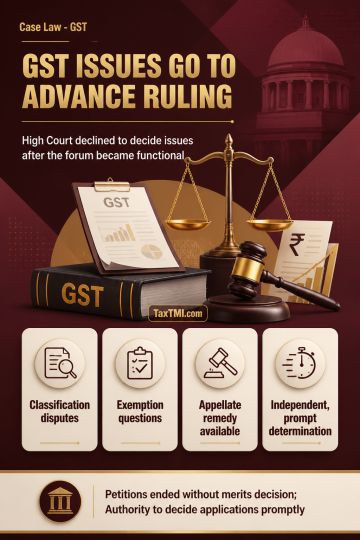
Advance-ruling mechanism governs pending GST classification, exemption and taxability disputes, limiting writ review once the specialised forum functi...
Page of 4805
Press 'Enter' after typing page number.
921 to 940 of 96092 Results
❮
❯
❯❯
0 / 200
Expand Note
Add to Folder
No Folders have been created
+
Are you sure you want to delete "My most important" ?
Domestic related-party transfer pricing is ordinarily revenue...
Revenue neutrality in domestic related-party loans can require deletion of interest transfer pricing adjustments after domestic-transaction verification.
Contents
Summary
Note
Bookmark
Share
✓ Copied successfully !
Print
Print Options
For full text, please login
Login to TaxTMI
Verification Pending
The Email Id has not been verified. Click on the link we have sent on
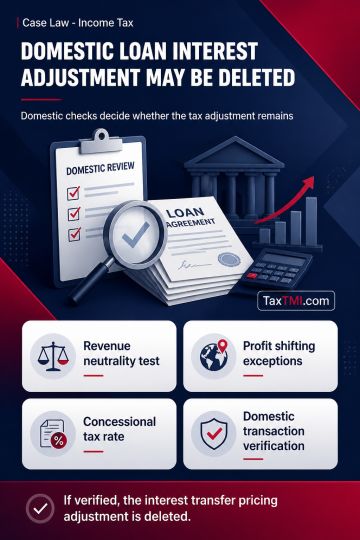
Domestic related-party transfer pricing is ordinarily revenue neutral where under-invoicing or over-invoicing does not create a tax advantage. Revenue neutrality may not apply where profits shift from a profit-making entity to a loss-making entity, or from a higher-taxed entity to a lower-taxed entity. Interest paid on a loan was examined where the borrower was subject to a lower concessional tax rate than the associated enterprise; shifting profit to the higher-taxed enterprise would not yield a tax benefit. Verification was required to establish whether the associated enterprise was domestic and the loan constituted a specified domestic transaction. If verified, the interest transfer pricing adjustment was to be deleted.
Domestic related-party transfer pricing is ordinarily revenue neutral where under-invoicing or over-invoicing does not create a tax advantage. Revenue neutrality may not apply where profits shift from a profit-making entity to a loss-making entity, or from a higher-taxed entity to a lower-taxed entity. Interest paid on a loan was examined where the borrower was subject to a lower concessional tax rate than the associated enterprise; shifting profit to the higher-taxed enterprise would not yield a tax benefit. Verification was required to establish whether the associated enterprise was domestic and the loan constituted a specified domestic transaction. If verified, the interest transfer pricing adjustment was to be deleted.
Note: It is a system-generated summary and is for quick reference only.
 TaxTMI
 of 4805













 Join Channel


 TaxTMI