Transaction value rejection requires reliable corroboration; refundable VAT is excluded and temporary registration does not defeat new-vehicle exempti...
Appellate jurisdiction remains available where a wrist-worn gold ornament cannot conclusively be characterised as imported baggage at the preliminary ...
Written complaint requirement bars cognizance on police reports for securities offences, while unsupported breach of trust and cheating allegations fa...
Risk-based postal import clearance standardises electronic assessment, document requests, duty realisation and delivery controls at Foreign Post Offic...
Page of 4786
Press 'Enter' after typing page number.
61 to 80 of 95715 Results
❮
❯
❯❯
0 / 200
Expand Note
Add to Folder
No Folders have been created
+
Are you sure you want to delete "My most important" ?
Domestic related-party transfer pricing is ordinarily revenue...
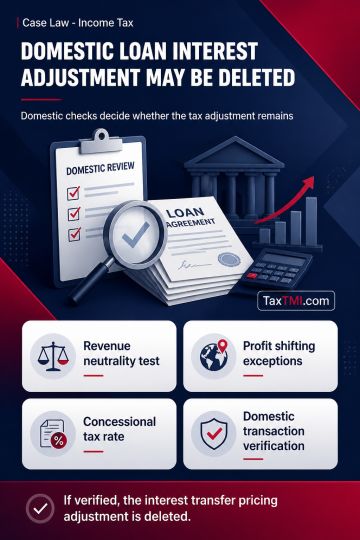
Revenue neutrality in domestic related-party loans can require deletion of interest transfer pricing adjustments after domestic-transaction verification.
Contents
Summary
Note
Bookmark
Share
✓ Copied successfully !
Print
Print Options
For full text, please login
Login to TaxTMI
Verification Pending
The Email Id has not been verified. Click on the link we have sent on
Domestic related-party transfer pricing is ordinarily revenue neutral where under-invoicing or over-invoicing does not create a tax advantage. Revenue neutrality may not apply where profits shift from a profit-making entity to a loss-making entity, or from a higher-taxed entity to a lower-taxed entity. Interest paid on a loan was examined where the borrower was subject to a lower concessional tax rate than the associated enterprise; shifting profit to the higher-taxed enterprise would not yield a tax benefit. Verification was required to establish whether the associated enterprise was domestic and the loan constituted a specified domestic transaction. If verified, the interest transfer pricing adjustment was to be deleted.
Domestic related-party transfer pricing is ordinarily revenue neutral where under-invoicing or over-invoicing does not create a tax advantage. Revenue neutrality may not apply where profits shift from a profit-making entity to a loss-making entity, or from a higher-taxed entity to a lower-taxed entity. Interest paid on a loan was examined where the borrower was subject to a lower concessional tax rate than the associated enterprise; shifting profit to the higher-taxed enterprise would not yield a tax benefit. Verification was required to establish whether the associated enterprise was domestic and the loan constituted a specified domestic transaction. If verified, the interest transfer pricing adjustment was to be deleted.
Note: It is a system-generated summary and is for quick reference only.
 TaxTMI
 of 4786










 Join Channel


 TaxTMI