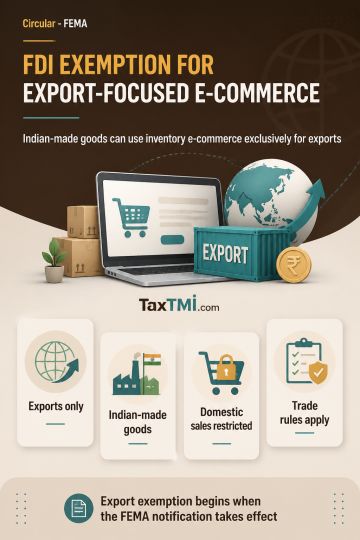
Inherited property sale proceeds require capital-gains treatment where ownership is supported by evidence, not suspicion or unverified signature doubt...
Cross-examination of retracted statements is essential where foundational evidence supports a benami allegation and documented funding explanations re...
Capital-goods exemption covers plant-modernisation accessories, while the import restriction applies only to earlier capital-goods components and spar...
Constitutional judicial review permits challenges to ECIRs and connected money-laundering proceedings where coercive action affects fundamental intere...
Domestic related-party transfer pricing is ordinarily revenue...
Revenue neutrality in domestic related-party loans can require deletion of interest transfer pricing adjustments after domestic-transaction verification.
Contents
Summary
Note
Bookmark
Share
✓ Copied successfully !
Print
Print Options
For full text, please login
Login to TaxTMI
Verification Pending
The Email Id has not been verified. Click on the link we have sent on
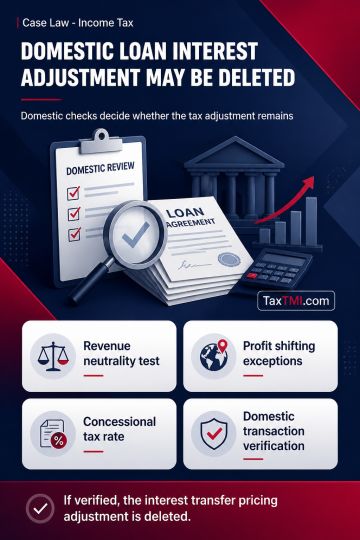
Domestic related-party transfer pricing is ordinarily revenue neutral where under-invoicing or over-invoicing does not create a tax advantage. Revenue neutrality may not apply where profits shift from a profit-making entity to a loss-making entity, or from a higher-taxed entity to a lower-taxed entity. Interest paid on a loan was examined where the borrower was subject to a lower concessional tax rate than the associated enterprise; shifting profit to the higher-taxed enterprise would not yield a tax benefit. Verification was required to establish whether the associated enterprise was domestic and the loan constituted a specified domestic transaction. If verified, the interest transfer pricing adjustment was to be deleted.
Domestic related-party transfer pricing is ordinarily revenue neutral where under-invoicing or over-invoicing does not create a tax advantage. Revenue neutrality may not apply where profits shift from a profit-making entity to a loss-making entity, or from a higher-taxed entity to a lower-taxed entity. Interest paid on a loan was examined where the borrower was subject to a lower concessional tax rate than the associated enterprise; shifting profit to the higher-taxed enterprise would not yield a tax benefit. Verification was required to establish whether the associated enterprise was domestic and the loan constituted a specified domestic transaction. If verified, the interest transfer pricing adjustment was to be deleted.
Note: It is a system-generated summary and is for quick reference only.
 TaxTMI
 of 4788










 Join Channel


 TaxTMI