Rectification of mistake remains limited to self-evident record errors, preventing merits review through miscellaneous applications and preserving fin...
Tender creditworthiness conditions may extend to de facto Promoter Directors, with post-participation challenges generally barred absent arbitrariness...
Corporate representation in PMLA summons proceedings permitted through an authorised signatory, subject to directors' continuing cooperation and atten...
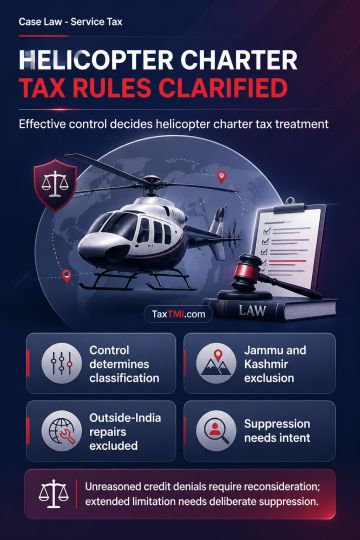
Helicopter charter classification requires effective control analysis, while territorial performance, reasoned credit orders and wilful suppression de...
Page of 4796
Press 'Enter' after typing page number.
781 to 800 of 95918 Results
❮
❯
❯❯
0 / 200
Expand Note
Add to Folder
No Folders have been created
+
Are you sure you want to delete "My most important" ?
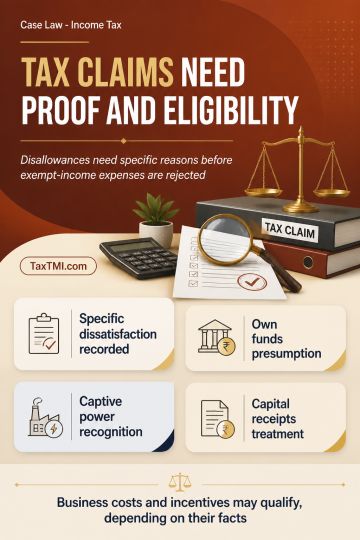
Rule 8D disallowance requires the Assessing Officer to record specific dissatisfaction, after examining the taxpayer's working, before indirect expenditure relating to exempt income can be disallowed; general observations on investments are insufficient. Where own interest-free funds cover exempt-income investments, a presumption applies that those investments were made from such funds, preventing interest disallowance. Eligible captive power undertakings may compute profits on a standalone basis, use regulated industrial tariffs as an internal comparable for captive electricity, and claim investment allowance when capital work-in-progress is installed and commissioned during the year. Corporate advertising, lease equalisation charges and employee stock-option costs may qualify as revenue expenditure. Subsidies linked to technology-upgradation investment are capital receipts, while scheme-based incentives require factual examination.
Rule 8D disallowance requires the Assessing Officer to record specific dissatisfaction, after examining the taxpayer's working, before indirect expenditure relating to exempt income can be disallowed; general observations on investments are insufficient. Where own interest-free funds cover exempt-income investments, a presumption applies that those investments were made from such funds, preventing interest disallowance. Eligible captive power undertakings may compute profits on a standalone basis, use regulated industrial tariffs as an internal comparable for captive electricity, and claim investment allowance when capital work-in-progress is installed and commissioned during the year. Corporate advertising, lease equalisation charges and employee stock-option costs may qualify as revenue expenditure. Subsidies linked to technology-upgradation investment are capital receipts, while scheme-based incentives require factual examination.
Note: It is a system-generated summary and is for quick reference only.
 TaxTMI
 of 4796












 Join Channel


 TaxTMI