Necessary-party requirements limit impleadment of independent entities, while deferred consideration does not create an appealable adverse determinati...
Food supplement classification requires common parlance and authoritative tests, preventing treatment as proprietary Ayurvedic medicines without suppo...
Specified regulatory authority income receives conditional tax exemption, subject to non-commercial activity, unchanged income character, and return f...
Tax exemption for regulatory authority income applies retrospectively, subject to non-commercial activity, unchanged income sources, and return-filing...
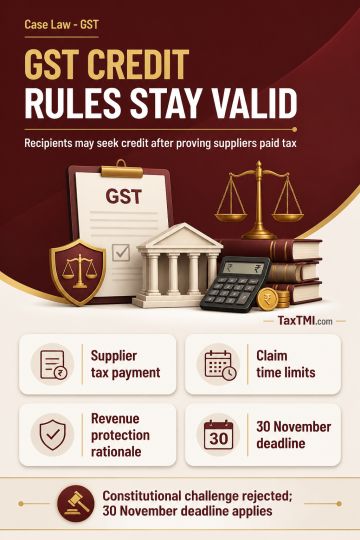
Input tax credit conditions remain constitutionally valid, with eligible recipient claims considered under GST circulars and retrospective filing dead...
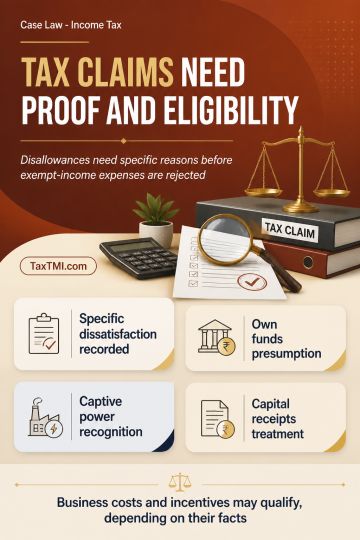
Rule 8D disallowance requires the Assessing Officer to record specific dissatisfaction, after examining the taxpayer's working, before indirect expenditure relating to exempt income can be disallowed; general observations on investments are insufficient. Where own interest-free funds cover exempt-income investments, a presumption applies that those investments were made from such funds, preventing interest disallowance. Eligible captive power undertakings may compute profits on a standalone basis, use regulated industrial tariffs as an internal comparable for captive electricity, and claim investment allowance when capital work-in-progress is installed and commissioned during the year. Corporate advertising, lease equalisation charges and employee stock-option costs may qualify as revenue expenditure. Subsidies linked to technology-upgradation investment are capital receipts, while scheme-based incentives require factual examination.
Rule 8D disallowance requires the Assessing Officer to record specific dissatisfaction, after examining the taxpayer's working, before indirect expenditure relating to exempt income can be disallowed; general observations on investments are insufficient. Where own interest-free funds cover exempt-income investments, a presumption applies that those investments were made from such funds, preventing interest disallowance. Eligible captive power undertakings may compute profits on a standalone basis, use regulated industrial tariffs as an internal comparable for captive electricity, and claim investment allowance when capital work-in-progress is installed and commissioned during the year. Corporate advertising, lease equalisation charges and employee stock-option costs may qualify as revenue expenditure. Subsidies linked to technology-upgradation investment are capital receipts, while scheme-based incentives require factual examination.
Note: It is a system-generated summary and is for quick reference only.
 TaxTMI
 of 4794


















 Join Channel


 TaxTMI