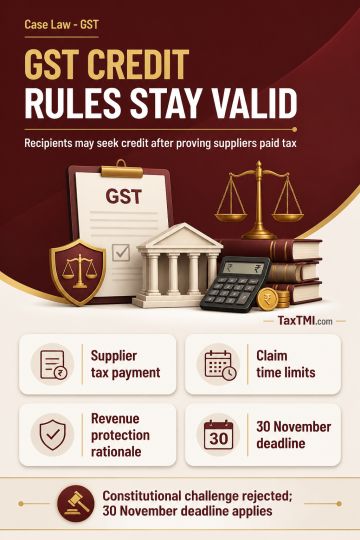
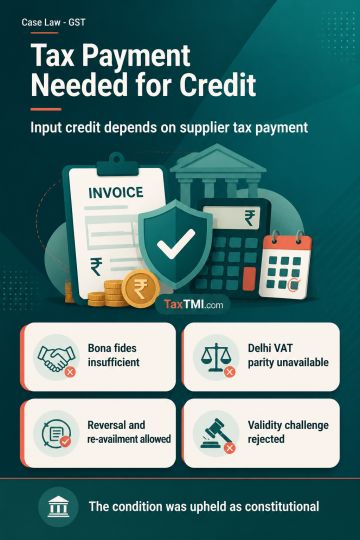
Input tax credit conditions remain constitutionally valid, with eligible recipient claims considered under GST circulars and retrospective filing dead...
Bogus donation receipts justified commission income assessment and defeated political-party tax exemption for inaccurate accounts and reporting failur...
Pure reimbursement without income element escapes tax withholding, while delayed withholding and unsupported provisions face deferred or renewed scrut...
Public benefit requirement defeats charitable registration where residents' association services are reciprocal, member-only facilities governed by mu...
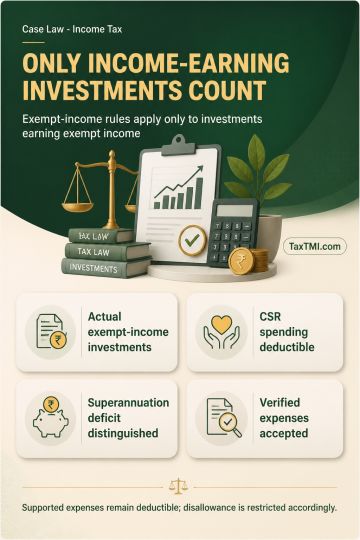
Exempt-income expenditure disallowance is confined to investments that actually generated exempt income, while supported business expenses remain dedu...
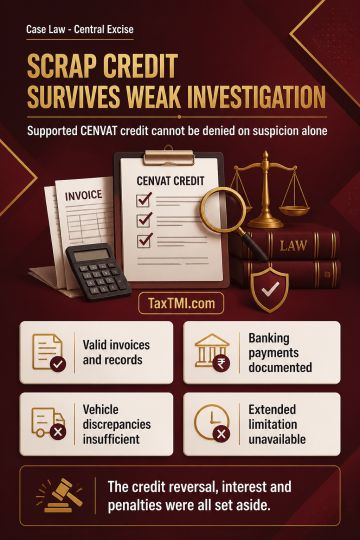
CENVAT credit on MS scrap received under registered dealer invoices was admissible where valid invoices, banking payments, statutory records, transport-service tax and evidence of consumption supported receipt, while manufacture and clearance of finished goods remained undisputed. The Revenue had to prove non-receipt through affirmative evidence and identify an alternative raw-material source; suspicion and incomplete investigation were insufficient. Uncorroborated, contradictory investigation statements could not sustain denial without compliance with Section 9D safeguards. Limited Vahan portal vehicle discrepancies, without examination of vehicle owners or independent evidence, could not establish fictitious transactions. Extended limitation was unavailable because statutory returns and records disclosed the credit and no fraud, collusion, wilful misstatement or suppression with intent to evade duty was proved. Credit reversal, interest and penalties were set aside.
CENVAT credit on MS scrap received under registered dealer invoices was admissible where valid invoices, banking payments, statutory records, transport-service tax and evidence of consumption supported receipt, while manufacture and clearance of finished goods remained undisputed. The Revenue had to prove non-receipt through affirmative evidence and identify an alternative raw-material source; suspicion and incomplete investigation were insufficient. Uncorroborated, contradictory investigation statements could not sustain denial without compliance with Section 9D safeguards. Limited Vahan portal vehicle discrepancies, without examination of vehicle owners or independent evidence, could not establish fictitious transactions. Extended limitation was unavailable because statutory returns and records disclosed the credit and no fraud, collusion, wilful misstatement or suppression with intent to evade duty was proved. Credit reversal, interest and penalties were set aside.
Note: It is a system-generated summary and is for quick reference only.
 TaxTMI
 of 4798















 Join Channel


 TaxTMI