Prolonged sterilisation of development rights supports capital-gains treatment, while business-income disallowances cannot govern capital-gains comput...
Additional evidence in transfer pricing dispute leads to fresh examination, while tax deductions, TDS credit, fee and refund interest require verifica...
Category II AIF pass-through taxation preserves non-business income character; investment receipts cannot be reclassified without applying recognised ...
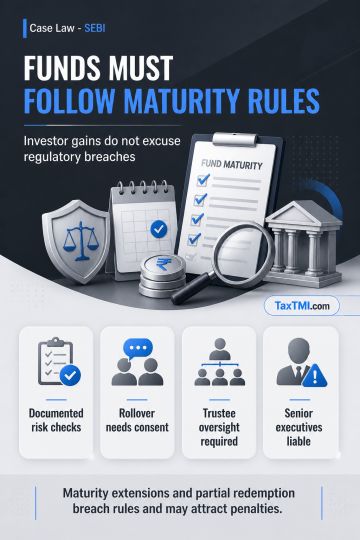
Mutual fund maturity rules require proper rollover, redemption, disclosure, and due diligence; investor gains cannot excuse regulatory breaches or pen...
Threshold exemption excludes exempt services, while stamp-paper purchases avoid reverse charge; consequential service tax penalties were also set asid...
The SOP for movement and cross-stuffing of International...
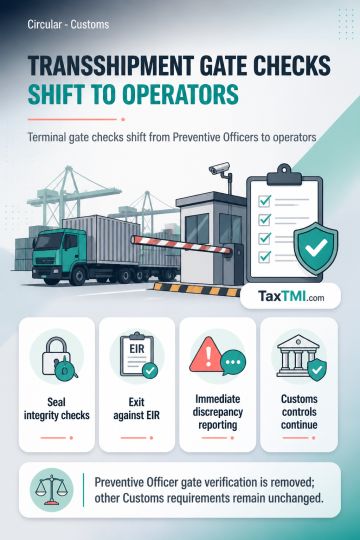
Terminal gate verification for transshipment containers shifts to operators, while Customs controls and discrepancy reporting requirements remain mandatory.
Contents
Summary
Note
Bookmark
Share
✓ Copied successfully !
Print
Print Options
For full text, please login
Login to TaxTMI
Verification Pending
The Email Id has not been verified. Click on the link we have sent on
The SOP for movement and cross-stuffing of International Transshipment-FCL containers between Port Terminals and designated CFSs now requires the Port Terminal Operator to verify container numbers and seal integrity before permitting terminal exit or entry; exit verification must be undertaken against the EIR copy. Physical verification by the Preventive Officer at terminal gates is dispensed with to reduce congestion, while Customs control continues through the Custodian-cum-Carrier Bond under HCCAR, 2009. Any container-number or seal discrepancy found during transit or upon arrival must be immediately reported to the jurisdictional AC/DC, and further processing requires the proper officer's permission. All other Customs checks and statutory requirements continue unchanged, with immediate effect.
The SOP for movement and cross-stuffing of International Transshipment-FCL containers between Port Terminals and designated CFSs now requires the Port Terminal Operator to verify container numbers and seal integrity before permitting terminal exit or entry; exit verification must be undertaken against the EIR copy. Physical verification by the Preventive Officer at terminal gates is dispensed with to reduce congestion, while Customs control continues through the Custodian-cum-Carrier Bond under HCCAR, 2009. Any container-number or seal discrepancy found during transit or upon arrival must be immediately reported to the jurisdictional AC/DC, and further processing requires the proper officer's permission. All other Customs checks and statutory requirements continue unchanged, with immediate effect.
Note: It is a system-generated summary and is for quick reference only.
 TaxTMI
 of 4805

















 Join Channel


 TaxTMI
