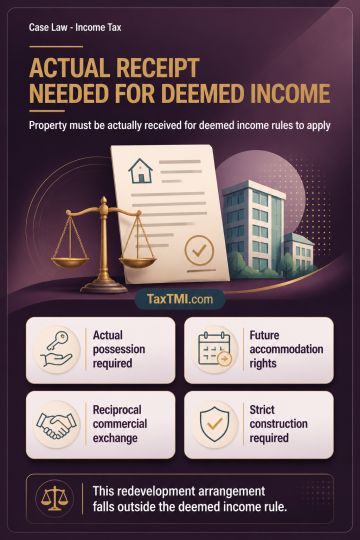
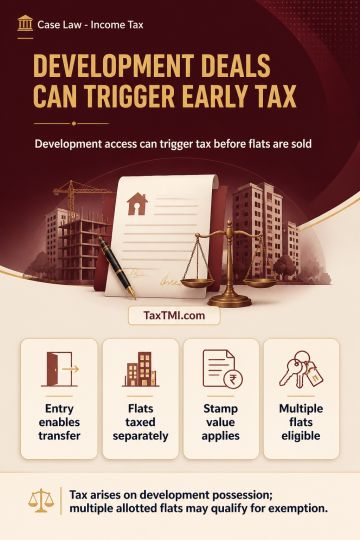
Receipt of immovable property requires actual possession or enjoyment; redevelopment allotments exchanged for tenancy rights fall outside deemed incom...
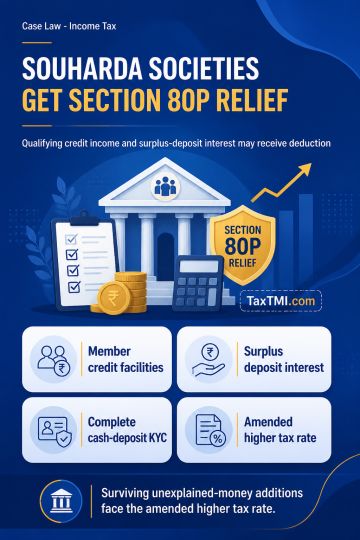
Section 80P deduction covers Souharda credit societies, including qualifying surplus-deposit interest, subject to member KYC verification for cash dep...
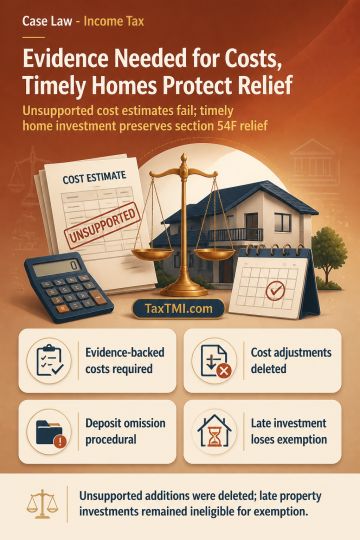
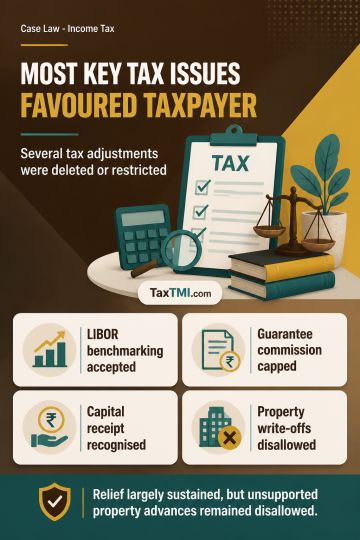
Transfer-pricing benchmarking and capital-receipt principles sustained taxpayer relief, while unsupported property-advance write-offs remained disallo...
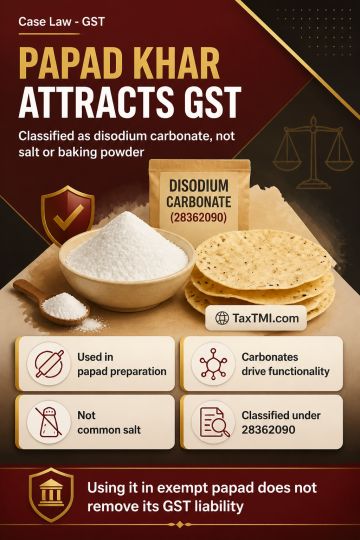
Papad Khar, an alkaline mixture of sodium chloride, sodium carbonate and sodium bicarbonate used in papad and snack preparation, is classified as other disodium carbonate under sub-heading 28362090. Its manufacture by mixing and processing prevents classification as common or rock salt under heading 2501, while its composition and culinary function distinguish it from yeast or prepared baking powder under heading 2102. Sodium chloride serves principally as a diluent or carrier, whereas the carbonates and bicarbonates provide the functional properties. As an inorganic chemical, Papad Khar attracts GST at 18%. The GST exemption for papad does not extend to Papad Khar merely because it is used as an input in manufacturing exempt papad.
Papad Khar, an alkaline mixture of sodium chloride, sodium carbonate and sodium bicarbonate used in papad and snack preparation, is classified as other disodium carbonate under sub-heading 28362090. Its manufacture by mixing and processing prevents classification as common or rock salt under heading 2501, while its composition and culinary function distinguish it from yeast or prepared baking powder under heading 2102. Sodium chloride serves principally as a diluent or carrier, whereas the carbonates and bicarbonates provide the functional properties. As an inorganic chemical, Papad Khar attracts GST at 18%. The GST exemption for papad does not extend to Papad Khar merely because it is used as an input in manufacturing exempt papad.
Note: It is a system-generated summary and is for quick reference only.
 TaxTMI
 of 4800







 Join Channel


 TaxTMI
