Inherited property sale proceeds require capital-gains treatment where ownership is supported by evidence, not suspicion or unverified signature doubt...
Cross-examination of retracted statements is essential where foundational evidence supports a benami allegation and documented funding explanations re...
Capital-goods exemption covers plant-modernisation accessories, while the import restriction applies only to earlier capital-goods components and spar...
Constitutional judicial review permits challenges to ECIRs and connected money-laundering proceedings where coercive action affects fundamental intere...
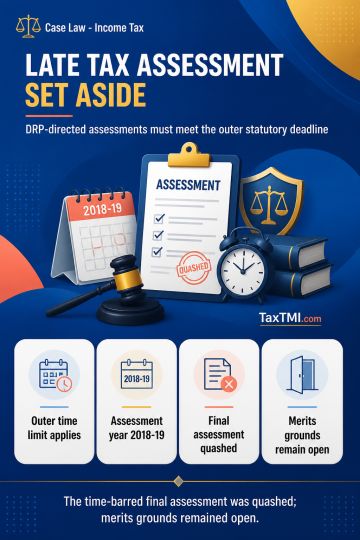
Sections 144C and 153 require harmonious construction when determining limitation for a final assessment made pursuant to DRP directions. The non-obstante clause in section 144C(13) does not displace the outer time limit under section 153; the final assessment must therefore be completed within that prescribed limitation period. Applying the binding High Court precedent, the ITAT treated the final assessment for Assessment Year 2018-19 as time-barred and quashed it. Merits grounds remained open, with liberty to seek revival if a Supreme Court decision requires modification.
Sections 144C and 153 require harmonious construction when determining limitation for a final assessment made pursuant to DRP directions. The non-obstante clause in section 144C(13) does not displace the outer time limit under section 153; the final assessment must therefore be completed within that prescribed limitation period. Applying the binding High Court precedent, the ITAT treated the final assessment for Assessment Year 2018-19 as time-barred and quashed it. Merits grounds remained open, with liberty to seek revival if a Supreme Court decision requires modification.
Note: It is a system-generated summary and is for quick reference only.
 TaxTMI
 of 4784


















 Join Channel


 TaxTMI