Authentication of paper assessment orders upheld, while qualifying repairs, consumables and vendor advance write-offs remain deductible business claim...
Transaction value cannot be rejected solely on non-statutory valuation guidelines without corroborative evidence supporting reassessment of final cust...
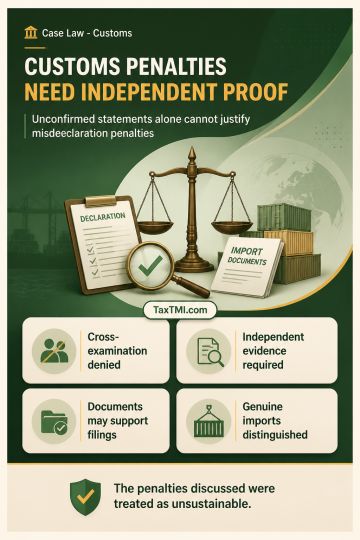
Cross-examination rights and corroborated evidence limit customs penalties for misdeclaration in genuine import transactions involving documented clea...
Tariff classification of vehicle gear components follows the specific gearing entry, displacing motor-vehicle parts classification and related liabili...
Page of 4794
Press 'Enter' after typing page number.
541 to 560 of 95875 Results
❮
❯
❯❯
0 / 200
Expand Note
Add to Folder
No Folders have been created
+
Are you sure you want to delete "My most important" ?
Section 44(1)(c) of the PMLA permits committal of a scheduled-offence case to the Special Court only after both the scheduled offence and the money-laundering complaint have been taken cognizance of by different courts. A pre-cognizance appearance notice under the BNSS does not satisfy that requirement, and absence of the required prosecution sanction further makes a committal request premature. Committal remains discretionary and must serve the interests of justice, including avoiding inconsistent findings without delaying a substantially concluded scheduled-offence trial. Where evidence and final arguments have substantially progressed, transfer to a Special Court dealing with a complaint still at the pre-cognizance stage may prejudice the accused and undermine speedy trial.
Section 44(1)(c) of the PMLA permits committal of a scheduled-offence case to the Special Court only after both the scheduled offence and the money-laundering complaint have been taken cognizance of by different courts. A pre-cognizance appearance notice under the BNSS does not satisfy that requirement, and absence of the required prosecution sanction further makes a committal request premature. Committal remains discretionary and must serve the interests of justice, including avoiding inconsistent findings without delaying a substantially concluded scheduled-offence trial. Where evidence and final arguments have substantially progressed, transfer to a Special Court dealing with a complaint still at the pre-cognizance stage may prejudice the accused and undermine speedy trial.
Note: It is a system-generated summary and is for quick reference only.
 TaxTMI
 of 4794




















 Join Channel



 TaxTMI

