Defined public benefit can retain charitable character; registration renewal requires examining genuine activities and legal compliance, not surplus a...
Capital reduction is distinct from share buy-back, preventing buy-back tax; restructuring interest and related business deductions also survive scruti...
Transfer pricing and tax deductions upheld on established principles, while employee contributions and warranty provisions returned for fresh examinat...
Captive transfer pricing relies on industrial consumer tariffs, while genuine quotations can benchmark effluent treatment transfers under the Other Me...
Specific tariff classification for ophthalmic instruments and extended limitation principles determine the treatment of duty demands, confiscation, an...
Page of 4801
Press 'Enter' after typing page number.
1161 to 1180 of 96001 Results
❮
❯
❯❯
0 / 200
Expand Note
Add to Folder
No Folders have been created
+
Are you sure you want to delete "My most important" ?
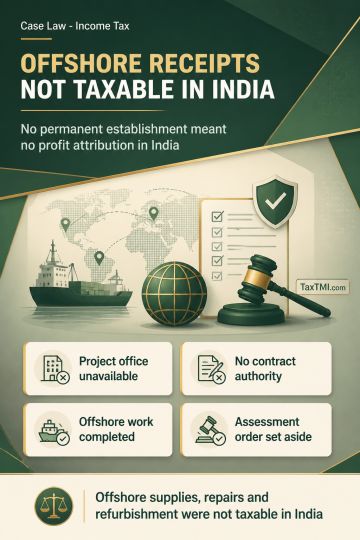
Permanent establishment requirements under Article 5 of the India-US DTAA were not met because the Revenue did not establish that the associated enterprise's project office was available to the assessee or that it habitually concluded contracts, maintained stock, or secured orders for it. No fixed place PE or dependent agent PE existed, so no profit attribution arose. Separate offshore supply and repair agreements were supported by the bid terms and contractual arrangements; supplies, repairs and transfer of title occurred outside India. The allegation of artificial contract splitting lacked support. Accordingly, offshore supply, repair and refurbishment receipts were not taxable in India, and the assessment order was set aside.
Permanent establishment requirements under Article 5 of the India-US DTAA were not met because the Revenue did not establish that the associated enterprise's project office was available to the assessee or that it habitually concluded contracts, maintained stock, or secured orders for it. No fixed place PE or dependent agent PE existed, so no profit attribution arose. Separate offshore supply and repair agreements were supported by the bid terms and contractual arrangements; supplies, repairs and transfer of title occurred outside India. The allegation of artificial contract splitting lacked support. Accordingly, offshore supply, repair and refurbishment receipts were not taxable in India, and the assessment order was set aside.
Note: It is a system-generated summary and is for quick reference only.
 TaxTMI
 of 4801





















 Join Channel


 TaxTMI

