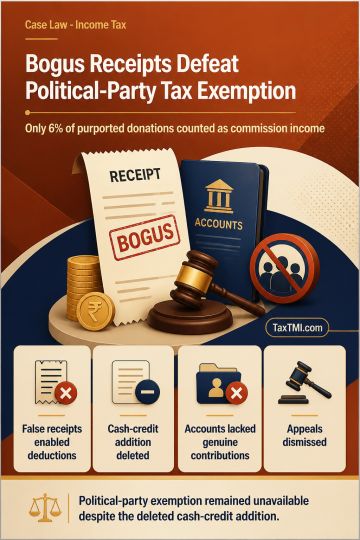
Bogus donation receipts justified commission income assessment and defeated political-party tax exemption for inaccurate accounts and reporting failur...
Pure reimbursement without income element escapes tax withholding, while delayed withholding and unsupported provisions face deferred or renewed scrut...
Public benefit requirement defeats charitable registration where residents' association services are reciprocal, member-only facilities governed by mu...
Exempt-income expenditure disallowance is confined to investments that actually generated exempt income, while supported business expenses remain dedu...
Substantial compliance with Order XXXIX Rule 3 CPC was found...
Ex parte injunction service requirements were substantially met, while civil recovery and SFIO investigation into provident fund defalcation continued.
Contents
Summary
Note
Bookmark
Share
✓ Copied successfully !
Print
Print Options
For full text, please login
Login to TaxTMI
Verification Pending
The Email Id has not been verified. Click on the link we have sent on
Substantial compliance with Order XXXIX Rule 3 CPC was found where defendants received the injunction application and plaint, relevant annexures were available, and service occurred before the returnable date, enabling an effective response; the interim injunction therefore continued. The exempted establishment had a prima facie civil claim over alleged provident fund trust defalcation, and statutory provident fund inquiry powers did not exclude civil court jurisdiction. Non-disclosure of a contemplated complaint and later FIR was not material suppression because it would not have affected interim relief; parallel civil and criminal proceedings could continue. The High Court could direct an SFIO investigation where the alleged diversion concerned company affairs, multiple units, and social-security funds.
Substantial compliance with Order XXXIX Rule 3 CPC was found where defendants received the injunction application and plaint, relevant annexures were available, and service occurred before the returnable date, enabling an effective response; the interim injunction therefore continued. The exempted establishment had a prima facie civil claim over alleged provident fund trust defalcation, and statutory provident fund inquiry powers did not exclude civil court jurisdiction. Non-disclosure of a contemplated complaint and later FIR was not material suppression because it would not have affected interim relief; parallel civil and criminal proceedings could continue. The High Court could direct an SFIO investigation where the alleged diversion concerned company affairs, multiple units, and social-security funds.
Note: It is a system-generated summary and is for quick reference only.
 TaxTMI
 of 4784














 Join Channel



 TaxTMI