Authentication of paper assessment orders upheld, while qualifying repairs, consumables and vendor advance write-offs remain deductible business claim...
Transaction value cannot be rejected solely on non-statutory valuation guidelines without corroborative evidence supporting reassessment of final cust...
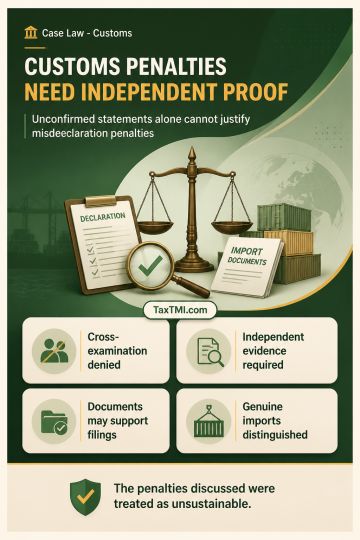
Cross-examination rights and corroborated evidence limit customs penalties for misdeclaration in genuine import transactions involving documented clea...
Page of 4782
Press 'Enter' after typing page number.
301 to 320 of 95636 Results
❮
❯
❯❯
0 / 200
Expand Note
Add to Folder
No Folders have been created
+
Are you sure you want to delete "My most important" ?
Substantial compliance with Order XXXIX Rule 3 CPC was found...
Ex parte injunction service requirements were substantially met, while civil recovery and SFIO investigation into provident fund defalcation continued.
Contents
Summary
Note
Bookmark
Share
✓ Copied successfully !
Print
Print Options
For full text, please login
Login to TaxTMI
Verification Pending
The Email Id has not been verified. Click on the link we have sent on
Substantial compliance with Order XXXIX Rule 3 CPC was found where defendants received the injunction application and plaint, relevant annexures were available, and service occurred before the returnable date, enabling an effective response; the interim injunction therefore continued. The exempted establishment had a prima facie civil claim over alleged provident fund trust defalcation, and statutory provident fund inquiry powers did not exclude civil court jurisdiction. Non-disclosure of a contemplated complaint and later FIR was not material suppression because it would not have affected interim relief; parallel civil and criminal proceedings could continue. The High Court could direct an SFIO investigation where the alleged diversion concerned company affairs, multiple units, and social-security funds.
Substantial compliance with Order XXXIX Rule 3 CPC was found where defendants received the injunction application and plaint, relevant annexures were available, and service occurred before the returnable date, enabling an effective response; the interim injunction therefore continued. The exempted establishment had a prima facie civil claim over alleged provident fund trust defalcation, and statutory provident fund inquiry powers did not exclude civil court jurisdiction. Non-disclosure of a contemplated complaint and later FIR was not material suppression because it would not have affected interim relief; parallel civil and criminal proceedings could continue. The High Court could direct an SFIO investigation where the alleged diversion concerned company affairs, multiple units, and social-security funds.
Note: It is a system-generated summary and is for quick reference only.
 TaxTMI
 of 4782
















 Join Channel



 TaxTMI