Development agreements require legal possession or effective enjoyment for capital gains transfer; permissive possession and deferred consideration de...
Prolonged sterilisation of development rights supports capital-gains treatment, while business-income disallowances cannot govern capital-gains comput...
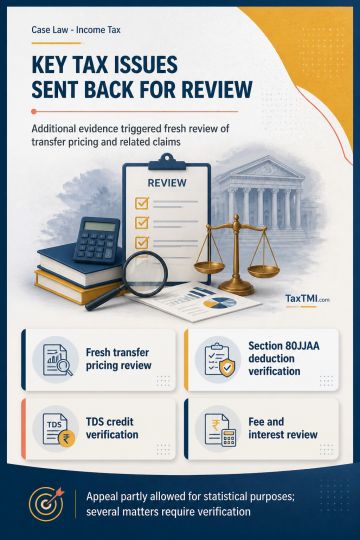
Additional evidence in transfer pricing dispute leads to fresh examination, while tax deductions, TDS credit, fee and refund interest require verifica...
Page of 4819
Press 'Enter' after typing page number.
1561 to 1580 of 96363 Results
❮
❯
❯❯
0 / 200
Expand Note
Add to Folder
No Folders have been created
+
Are you sure you want to delete "My most important" ?
Asset disclosure for prospective attachment may be ordered from the commencement of foreign proceedings where the period is undisputed; disclosure identifies assets and does not decide whether they are attachable. Certified foreign judgments carry a mandatory presumption of competent jurisdiction under the CPC, which must be rebutted by credible evidence rather than disagreement with findings or bare reliance on statutory exceptions. Prior anti-enforcement proceedings and findings concerning diversion of assets supported the disclosure and restraint directions. Appellate intervention in interlocutory discretion is limited to arbitrary, capricious, perverse, or legally erroneous exercises of discretion; a reasonably possible first-instance view should not be replaced. The disclosure and restraint directions were maintained and the appeal dismissed.
Asset disclosure for prospective attachment may be ordered from the commencement of foreign proceedings where the period is undisputed; disclosure identifies assets and does not decide whether they are attachable. Certified foreign judgments carry a mandatory presumption of competent jurisdiction under the CPC, which must be rebutted by credible evidence rather than disagreement with findings or bare reliance on statutory exceptions. Prior anti-enforcement proceedings and findings concerning diversion of assets supported the disclosure and restraint directions. Appellate intervention in interlocutory discretion is limited to arbitrary, capricious, perverse, or legally erroneous exercises of discretion; a reasonably possible first-instance view should not be replaced. The disclosure and restraint directions were maintained and the appeal dismissed.
Note: It is a system-generated summary and is for quick reference only.
 TaxTMI
  TaxTMI
 of 4819






















 Join Channel