Food supplement classification requires common parlance and authoritative tests, preventing treatment as proprietary Ayurvedic medicines without suppo...
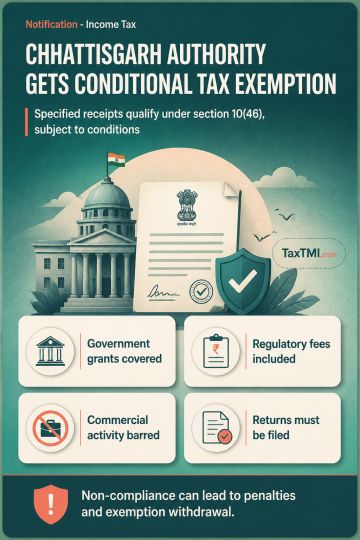
Specified regulatory authority income receives conditional tax exemption, subject to non-commercial activity, unchanged income character, and return f...
Tax exemption for regulatory authority income applies retrospectively, subject to non-commercial activity, unchanged income sources, and return-filing...
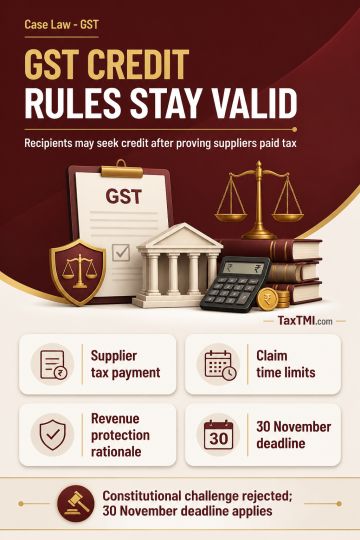
Input tax credit conditions remain constitutionally valid, with eligible recipient claims considered under GST circulars and retrospective filing dead...
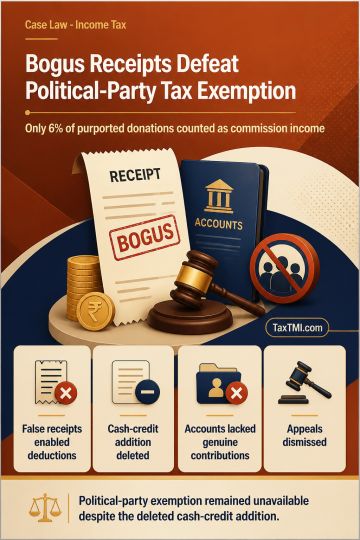
Bogus donation receipts justified commission income assessment and defeated political-party tax exemption for inaccurate accounts and reporting failur...
Page of 4811
Press 'Enter' after typing page number.
901 to 920 of 96208 Results
❮
❯
❯❯
0 / 200
Expand Note
Add to Folder
No Folders have been created
+
Are you sure you want to delete "My most important" ?
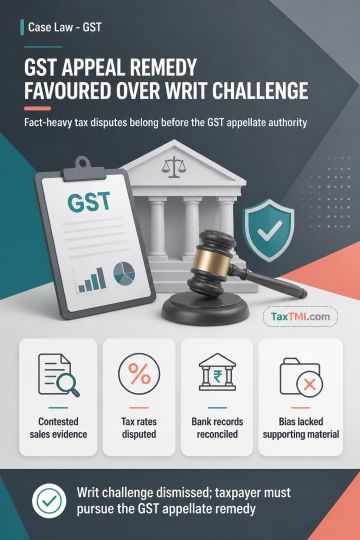
GST writ jurisdiction ordinarily does not displace the statutory appellate remedy where a demand dispute requires examination of contested evidence. The text identifies alleged suppressed sales, applicable tax rates, and reconciliation of bank deposits, returns and seized records as factual matters unsuitable for determination under Article 226. It further distinguishes cases involving pure questions of law. Authorisation of an inspection is described as distinct from adjudicatory functions; without material establishing bias, an officer's later appellate role does not itself demonstrate denial of natural justice, lack of authority or jurisdictional error. The stated result is that the writ challenge was dismissed, leaving the taxpayer to pursue the GST appellate remedy.
GST writ jurisdiction ordinarily does not displace the statutory appellate remedy where a demand dispute requires examination of contested evidence. The text identifies alleged suppressed sales, applicable tax rates, and reconciliation of bank deposits, returns and seized records as factual matters unsuitable for determination under Article 226. It further distinguishes cases involving pure questions of law. Authorisation of an inspection is described as distinct from adjudicatory functions; without material establishing bias, an officer's later appellate role does not itself demonstrate denial of natural justice, lack of authority or jurisdictional error. The stated result is that the writ challenge was dismissed, leaving the taxpayer to pursue the GST appellate remedy.
Note: It is a system-generated summary and is for quick reference only.
 TaxTMI
  TaxTMI
 of 4811











 Join Channel