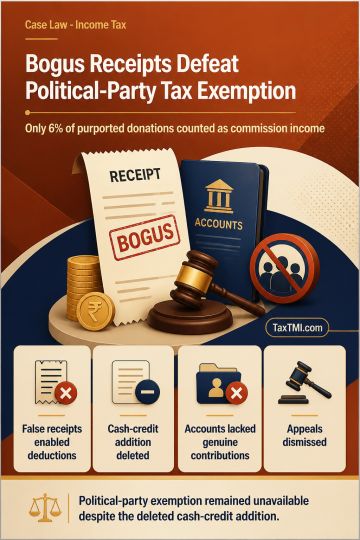
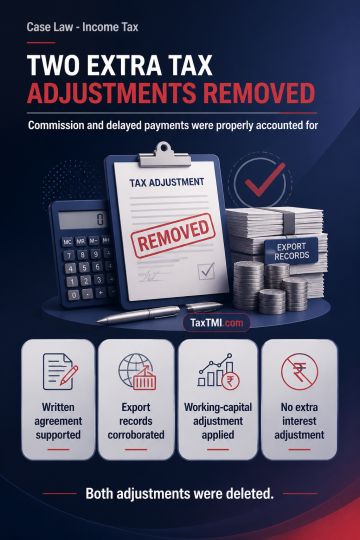
Bogus donation receipts justified commission income assessment and defeated political-party tax exemption for inaccurate accounts and reporting failur...
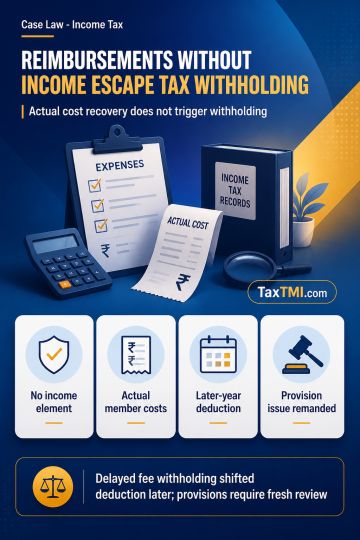
Pure reimbursement without income element escapes tax withholding, while delayed withholding and unsupported provisions face deferred or renewed scrut...
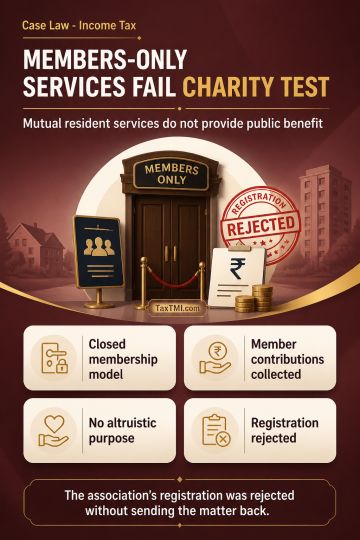
Public benefit requirement defeats charitable registration where residents' association services are reciprocal, member-only facilities governed by mu...
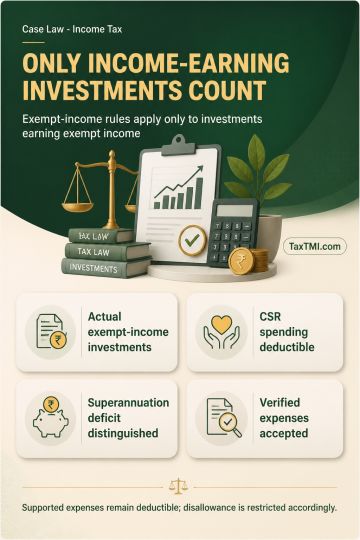
Exempt-income expenditure disallowance is confined to investments that actually generated exempt income, while supported business expenses remain dedu...
Objective characteristics and principal use govern mining-tyre classification, while fresh advance ruling applications may rely on additional technica...
Page of 4788
Press 'Enter' after typing page number.
461 to 480 of 95752 Results
❮
❯
❯❯
0 / 200
Expand Note
Add to Folder
No Folders have been created
+
Are you sure you want to delete "My most important" ?
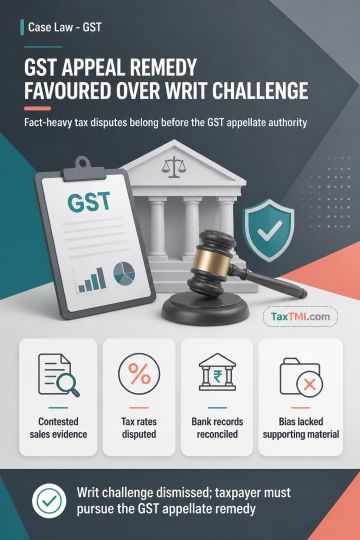
GST writ jurisdiction ordinarily does not displace the statutory appellate remedy where a demand dispute requires examination of contested evidence. The text identifies alleged suppressed sales, applicable tax rates, and reconciliation of bank deposits, returns and seized records as factual matters unsuitable for determination under Article 226. It further distinguishes cases involving pure questions of law. Authorisation of an inspection is described as distinct from adjudicatory functions; without material establishing bias, an officer's later appellate role does not itself demonstrate denial of natural justice, lack of authority or jurisdictional error. The stated result is that the writ challenge was dismissed, leaving the taxpayer to pursue the GST appellate remedy.
GST writ jurisdiction ordinarily does not displace the statutory appellate remedy where a demand dispute requires examination of contested evidence. The text identifies alleged suppressed sales, applicable tax rates, and reconciliation of bank deposits, returns and seized records as factual matters unsuitable for determination under Article 226. It further distinguishes cases involving pure questions of law. Authorisation of an inspection is described as distinct from adjudicatory functions; without material establishing bias, an officer's later appellate role does not itself demonstrate denial of natural justice, lack of authority or jurisdictional error. The stated result is that the writ challenge was dismissed, leaving the taxpayer to pursue the GST appellate remedy.
Note: It is a system-generated summary and is for quick reference only.
 TaxTMI
 of 4788




 Join Channel


 TaxTMI