Defined public benefit can retain charitable character; registration renewal requires examining genuine activities and legal compliance, not surplus a...
Capital reduction is distinct from share buy-back, preventing buy-back tax; restructuring interest and related business deductions also survive scruti...
Transfer pricing and tax deductions upheld on established principles, while employee contributions and warranty provisions returned for fresh examinat...
Captive transfer pricing relies on industrial consumer tariffs, while genuine quotations can benchmark effluent treatment transfers under the Other Me...
Specific tariff classification for ophthalmic instruments and extended limitation principles determine the treatment of duty demands, confiscation, an...
Integrated golf function determines classification, placing launch monitors and simulators under other golf equipment rather than measuring instrument...
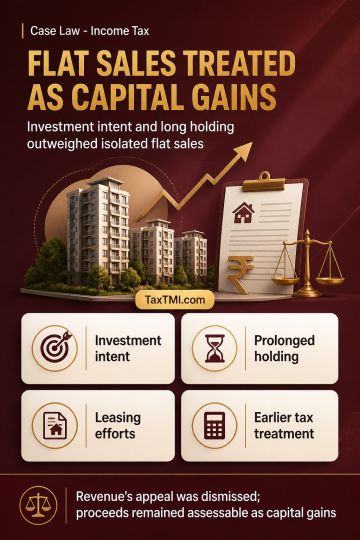
Characterisation of flat-sale proceeds depends primarily on the taxpayer's intention, determined from the totality of circumstances, including the stated objects, consistent investment treatment, period of holding, leasing efforts, absence of other projects, and lack of regular trading activity. Although book treatment is not conclusive, it is relevant. Sales over different years after unsuccessful efforts to obtain tenants did not amount to an adventure in the nature of trade. Where the Revenue had accepted capital-gains treatment in earlier years and no distinguishing facts or incriminating material existed, consistency required the same treatment. The proceeds were therefore assessable as capital gains rather than business income, and the Revenue's appeal was dismissed.
Characterisation of flat-sale proceeds depends primarily on the taxpayer's intention, determined from the totality of circumstances, including the stated objects, consistent investment treatment, period of holding, leasing efforts, absence of other projects, and lack of regular trading activity. Although book treatment is not conclusive, it is relevant. Sales over different years after unsuccessful efforts to obtain tenants did not amount to an adventure in the nature of trade. Where the Revenue had accepted capital-gains treatment in earlier years and no distinguishing facts or incriminating material existed, consistency required the same treatment. The proceeds were therefore assessable as capital gains rather than business income, and the Revenue's appeal was dismissed.
Note: It is a system-generated summary and is for quick reference only.
 TaxTMI
  TaxTMI
 of 4813






















 Join Channel