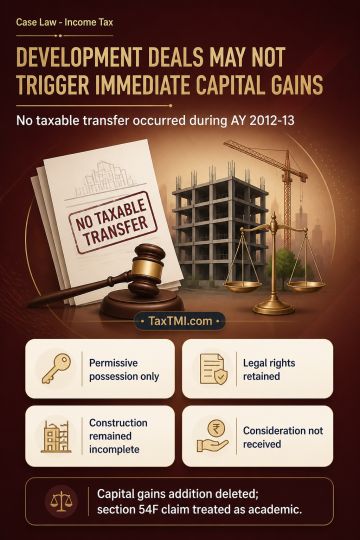
Development agreements require legal possession or effective enjoyment for capital gains transfer; permissive possession and deferred consideration de...
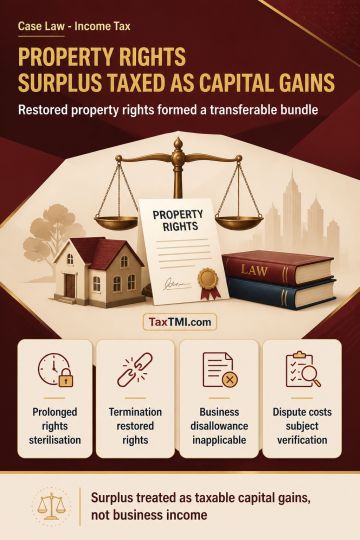
Prolonged sterilisation of development rights supports capital-gains treatment, while business-income disallowances cannot govern capital-gains comput...
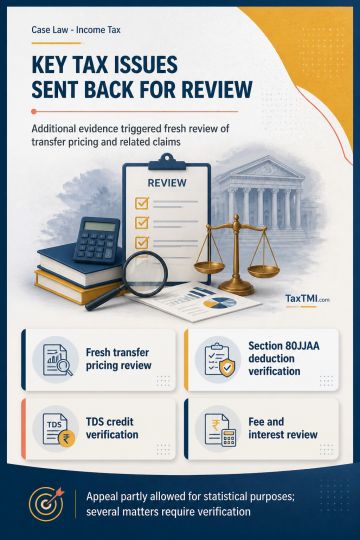
Additional evidence in transfer pricing dispute leads to fresh examination, while tax deductions, TDS credit, fee and refund interest require verifica...
Page of 4819
Press 'Enter' after typing page number.
1561 to 1580 of 96363 Results
❮
❯
❯❯
0 / 200
Expand Note
Add to Folder
No Folders have been created
+
Are you sure you want to delete "My most important" ?
Patent-settlement expenditure incurred under an out-of-court...
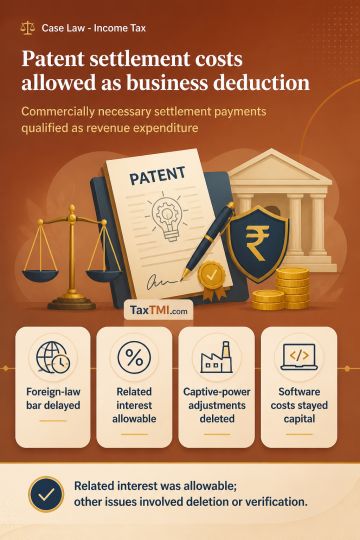
Patent-settlement expenditure treated as commercially expedient revenue outlay, with foreign-law restrictions inapplicable before the prospective amendment.
Contents
Summary
Note
Bookmark
Share
✓ Copied successfully !
Print
Print Options
For full text, please login
Login to TaxTMI
Verification Pending
The Email Id has not been verified. Click on the link we have sent on
Patent-settlement expenditure incurred under an out-of-court United States patent-infringement settlement is described as a revenue business deduction where it was compensatory, commercially expedient, and did not create a capital asset or enduring capital advantage. The notes state that, for the relevant year, Explanation 1 to section 37(1) did not cover alleged foreign-law contraventions, while Explanation 3 applied prospectively; consequential financing interest was also allowable. They further address deletion of captive-power and associated-enterprise transfer-pricing adjustments, restriction of exempt-income disallowance to exempt dividend without a book-profit adjustment, and verification of foreign-tax deductions. Software expenditure remained capital in character, while business-promotion expenditure required verification rather than ad hoc disallowance.
Patent-settlement expenditure incurred under an out-of-court United States patent-infringement settlement is described as a revenue business deduction where it was compensatory, commercially expedient, and did not create a capital asset or enduring capital advantage. The notes state that, for the relevant year, Explanation 1 to section 37(1) did not cover alleged foreign-law contraventions, while Explanation 3 applied prospectively; consequential financing interest was also allowable. They further address deletion of captive-power and associated-enterprise transfer-pricing adjustments, restriction of exempt-income disallowance to exempt dividend without a book-profit adjustment, and verification of foreign-tax deductions. Software expenditure remained capital in character, while business-promotion expenditure required verification rather than ad hoc disallowance.
Note: It is a system-generated summary and is for quick reference only.
 TaxTMI
  TaxTMI
 of 4819





 Join Channel