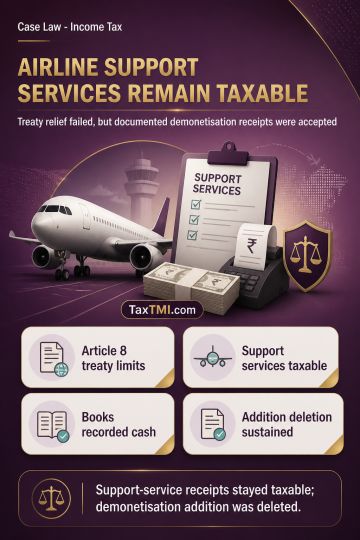
Article 8 treaty coverage excluded third-party airline support services, while documented demonetisation cash receipts remained accepted business inco...
Functional comparability under TNMM requires highway contract benchmarks to reflect operation, maintenance and transfer activities, requiring fresh be...
Objective characteristics govern magnesium bis-glycinate chelate classification as an amino-acid coordination compound, not a food preparation or anti...
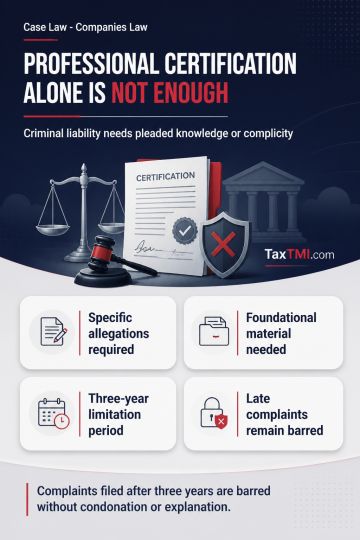
Independent professional certification requires pleaded knowledge or complicity for criminal liability; untimely complaints remain barred by limitatio...
Patent-settlement expenditure incurred under an out-of-court...
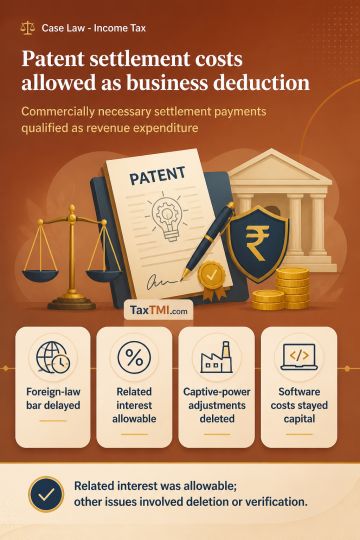
Patent-settlement expenditure treated as commercially expedient revenue outlay, with foreign-law restrictions inapplicable before the prospective amendment.
Contents
Summary
Note
Bookmark
Share
✓ Copied successfully !
Print
Print Options
For full text, please login
Login to TaxTMI
Verification Pending
The Email Id has not been verified. Click on the link we have sent on
Patent-settlement expenditure incurred under an out-of-court United States patent-infringement settlement is described as a revenue business deduction where it was compensatory, commercially expedient, and did not create a capital asset or enduring capital advantage. The notes state that, for the relevant year, Explanation 1 to section 37(1) did not cover alleged foreign-law contraventions, while Explanation 3 applied prospectively; consequential financing interest was also allowable. They further address deletion of captive-power and associated-enterprise transfer-pricing adjustments, restriction of exempt-income disallowance to exempt dividend without a book-profit adjustment, and verification of foreign-tax deductions. Software expenditure remained capital in character, while business-promotion expenditure required verification rather than ad hoc disallowance.
Patent-settlement expenditure incurred under an out-of-court United States patent-infringement settlement is described as a revenue business deduction where it was compensatory, commercially expedient, and did not create a capital asset or enduring capital advantage. The notes state that, for the relevant year, Explanation 1 to section 37(1) did not cover alleged foreign-law contraventions, while Explanation 3 applied prospectively; consequential financing interest was also allowable. They further address deletion of captive-power and associated-enterprise transfer-pricing adjustments, restriction of exempt-income disallowance to exempt dividend without a book-profit adjustment, and verification of foreign-tax deductions. Software expenditure remained capital in character, while business-promotion expenditure required verification rather than ad hoc disallowance.
Note: It is a system-generated summary and is for quick reference only.
 TaxTMI
  TaxTMI
 of 4816











 Join Channel