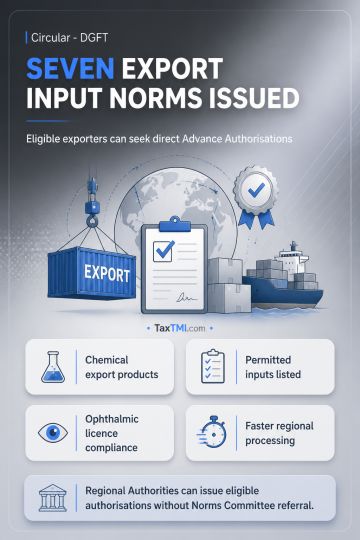
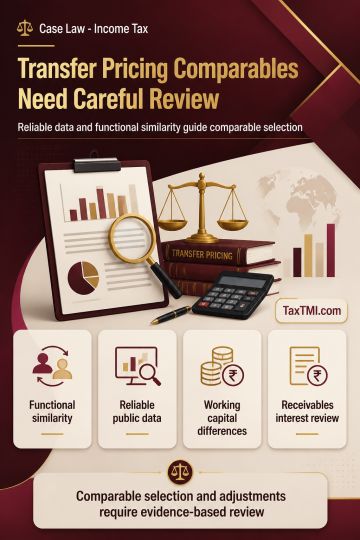
Transfer pricing comparability requires functional alignment, reliable financial data, and careful review of working capital and receivables adjustmen...
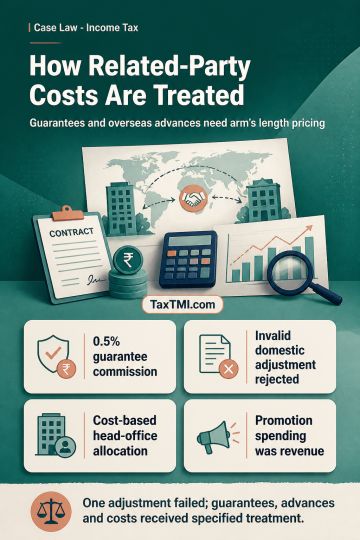
Transfer pricing rules require benchmarking corporate guarantees and associated-enterprise advances, while invalid domestic-transaction adjustments ca...
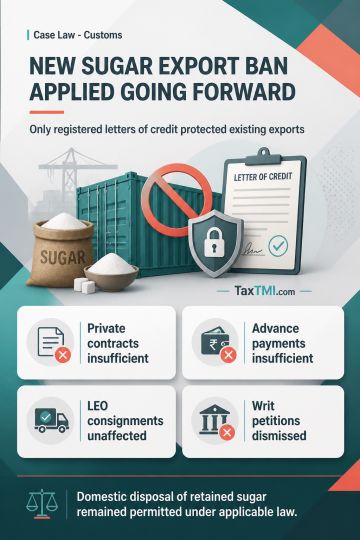
Prospective sugar export prohibition required registered letters of credit; private contracts and export quotas created no enforceable continuation ri...
Retroactive interim-moratorium exclusion permits protective asset disclosure and preservation measures against personal guarantors pending arbitration...
Patent-settlement expenditure incurred under an out-of-court...
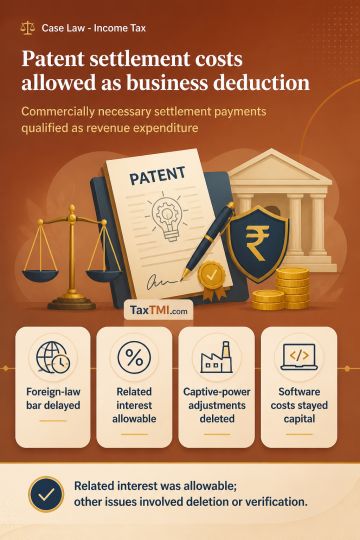
Patent-settlement expenditure treated as commercially expedient revenue outlay, with foreign-law restrictions inapplicable before the prospective amendment.
Contents
Summary
Note
Bookmark
Share
✓ Copied successfully !
Print
Print Options
For full text, please login
Login to TaxTMI
Verification Pending
The Email Id has not been verified. Click on the link we have sent on
Patent-settlement expenditure incurred under an out-of-court United States patent-infringement settlement is described as a revenue business deduction where it was compensatory, commercially expedient, and did not create a capital asset or enduring capital advantage. The notes state that, for the relevant year, Explanation 1 to section 37(1) did not cover alleged foreign-law contraventions, while Explanation 3 applied prospectively; consequential financing interest was also allowable. They further address deletion of captive-power and associated-enterprise transfer-pricing adjustments, restriction of exempt-income disallowance to exempt dividend without a book-profit adjustment, and verification of foreign-tax deductions. Software expenditure remained capital in character, while business-promotion expenditure required verification rather than ad hoc disallowance.
Patent-settlement expenditure incurred under an out-of-court United States patent-infringement settlement is described as a revenue business deduction where it was compensatory, commercially expedient, and did not create a capital asset or enduring capital advantage. The notes state that, for the relevant year, Explanation 1 to section 37(1) did not cover alleged foreign-law contraventions, while Explanation 3 applied prospectively; consequential financing interest was also allowable. They further address deletion of captive-power and associated-enterprise transfer-pricing adjustments, restriction of exempt-income disallowance to exempt dividend without a book-profit adjustment, and verification of foreign-tax deductions. Software expenditure remained capital in character, while business-promotion expenditure required verification rather than ad hoc disallowance.
Note: It is a system-generated summary and is for quick reference only.
 TaxTMI
 of 4778







 Join Channel


 TaxTMI