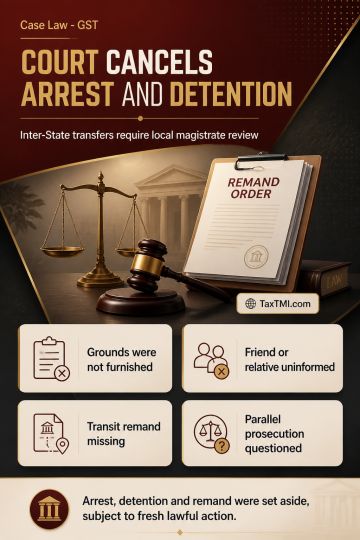
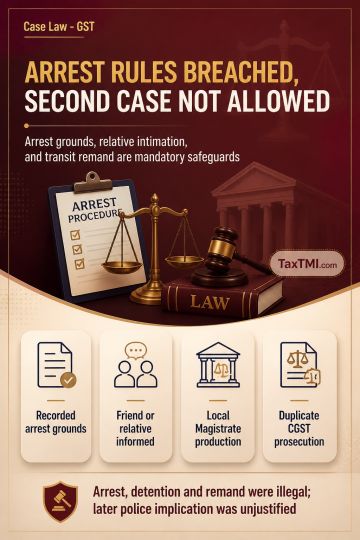
Arrest safeguards and transit remand requirements invalidated detention following inter-State transfer without communicated grounds or magistrate auth...
Arrest safeguards require disclosed grounds, relative intimation and transit remand, while duplicate prosecution under the CGST framework is unsustain...
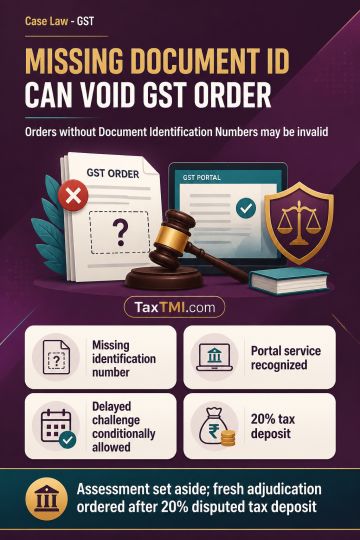
Document Identification Number defects can invalidate GST assessments, with delayed challenges entertained conditionally where patent irregularities e...
Windmill commissioning evidence supported higher depreciation where grid connection and electricity generation proved operational use before the relev...
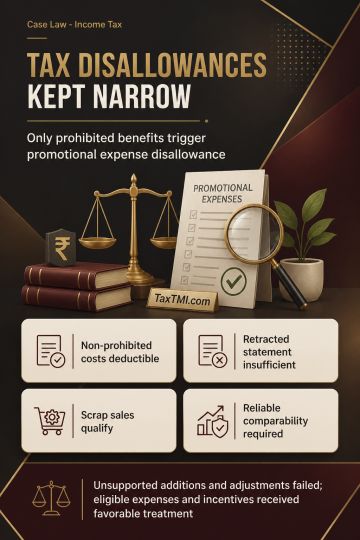
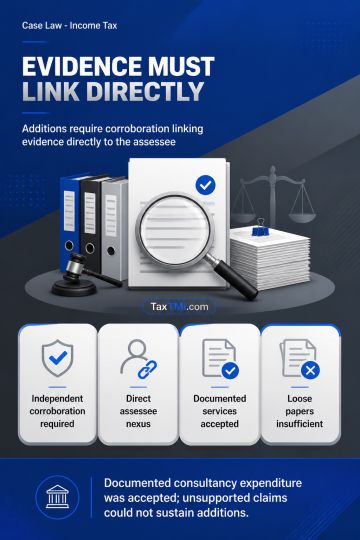
Pharmaceutical promotion and transfer-pricing comparability principles limited disallowances, while uncorroborated search allegations and unsupported ...
Patent-settlement expenditure incurred under an out-of-court...
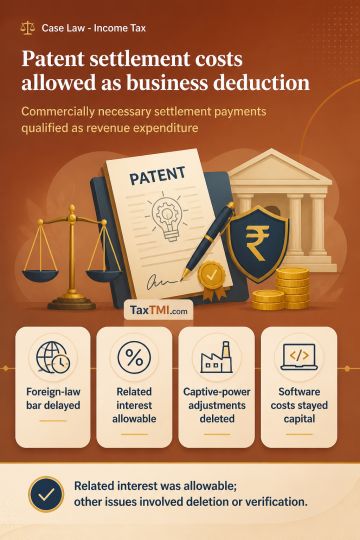
Patent-settlement expenditure treated as commercially expedient revenue outlay, with foreign-law restrictions inapplicable before the prospective amendment.
Contents
Summary
Note
Bookmark
Share
✓ Copied successfully !
Print
Print Options
For full text, please login
Login to TaxTMI
Verification Pending
The Email Id has not been verified. Click on the link we have sent on
Patent-settlement expenditure incurred under an out-of-court United States patent-infringement settlement is described as a revenue business deduction where it was compensatory, commercially expedient, and did not create a capital asset or enduring capital advantage. The notes state that, for the relevant year, Explanation 1 to section 37(1) did not cover alleged foreign-law contraventions, while Explanation 3 applied prospectively; consequential financing interest was also allowable. They further address deletion of captive-power and associated-enterprise transfer-pricing adjustments, restriction of exempt-income disallowance to exempt dividend without a book-profit adjustment, and verification of foreign-tax deductions. Software expenditure remained capital in character, while business-promotion expenditure required verification rather than ad hoc disallowance.
Patent-settlement expenditure incurred under an out-of-court United States patent-infringement settlement is described as a revenue business deduction where it was compensatory, commercially expedient, and did not create a capital asset or enduring capital advantage. The notes state that, for the relevant year, Explanation 1 to section 37(1) did not cover alleged foreign-law contraventions, while Explanation 3 applied prospectively; consequential financing interest was also allowable. They further address deletion of captive-power and associated-enterprise transfer-pricing adjustments, restriction of exempt-income disallowance to exempt dividend without a book-profit adjustment, and verification of foreign-tax deductions. Software expenditure remained capital in character, while business-promotion expenditure required verification rather than ad hoc disallowance.
Note: It is a system-generated summary and is for quick reference only.
 TaxTMI
 of 4782







 Join Channel


 TaxTMI
