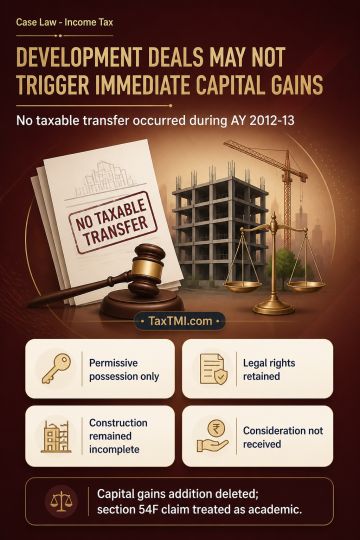
Development agreements require legal possession or effective enjoyment for capital gains transfer; permissive possession and deferred consideration de...
Prolonged sterilisation of development rights supports capital-gains treatment, while business-income disallowances cannot govern capital-gains comput...
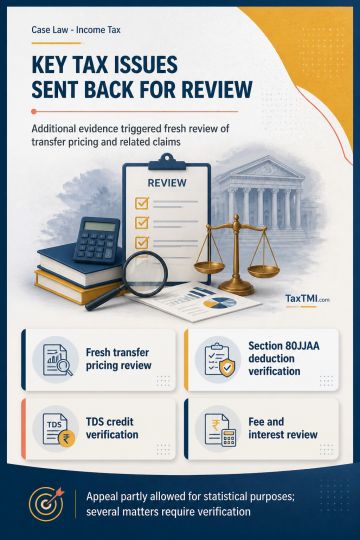
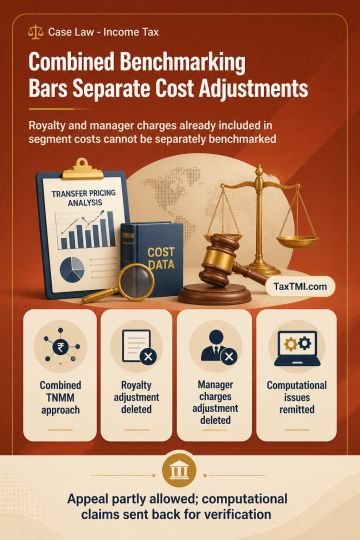
Additional evidence in transfer pricing dispute leads to fresh examination, while tax deductions, TDS credit, fee and refund interest require verifica...
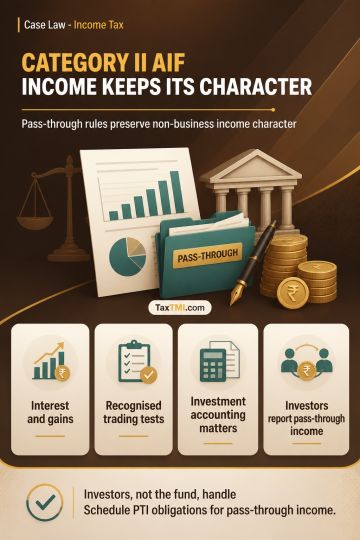
Category II AIF pass-through taxation preserves non-business income character; investment receipts cannot be reclassified without applying recognised ...
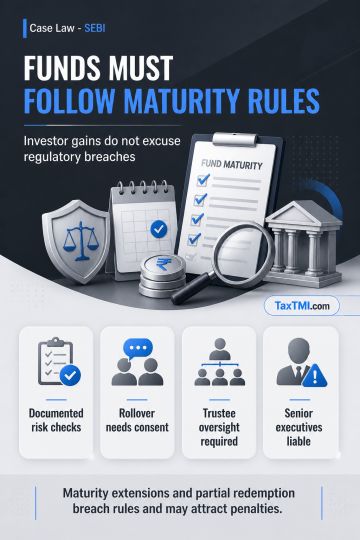
Mutual fund maturity rules require proper rollover, redemption, disclosure, and due diligence; investor gains cannot excuse regulatory breaches or pen...
Page of 4798
Press 'Enter' after typing page number.
1161 to 1180 of 95957 Results
❮
❯
❯❯
0 / 200
Expand Note
Add to Folder
No Folders have been created
+
Are you sure you want to delete "My most important" ?
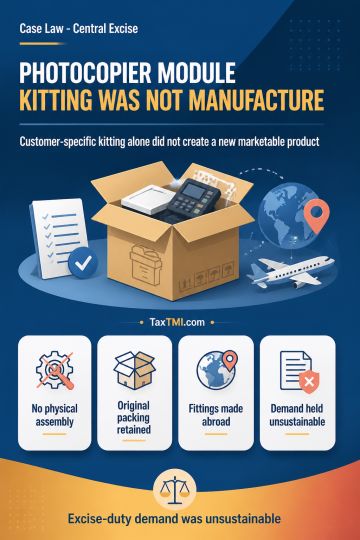
Manufacture for central excise requires transformation into a new, distinct and marketable commodity with a separate name, character and use; labour, skill, expense or value addition alone does not suffice. Kitting imported photocopier modules by unpacking and placing them into customer-specific sets was not manufacture where the components remained in original packing, no physical assembly occurred at the warehouse, and relevant fittings had been made abroad. Note 6 to Section XVI could not deem manufacture because the modules were imported and assessed as complete machines, with no subsequent conversion of incomplete goods into complete articles. Rule 2(a) governs classification only and does not determine manufacture. The excise-duty demand was unsustainable.
Manufacture for central excise requires transformation into a new, distinct and marketable commodity with a separate name, character and use; labour, skill, expense or value addition alone does not suffice. Kitting imported photocopier modules by unpacking and placing them into customer-specific sets was not manufacture where the components remained in original packing, no physical assembly occurred at the warehouse, and relevant fittings had been made abroad. Note 6 to Section XVI could not deem manufacture because the modules were imported and assessed as complete machines, with no subsequent conversion of incomplete goods into complete articles. Rule 2(a) governs classification only and does not determine manufacture. The excise-duty demand was unsustainable.
Note: It is a system-generated summary and is for quick reference only.
 TaxTMI
 of 4798






 Join Channel


 TaxTMI