Defined public benefit can retain charitable character; registration renewal requires examining genuine activities and legal compliance, not surplus a...
Capital reduction is distinct from share buy-back, preventing buy-back tax; restructuring interest and related business deductions also survive scruti...
Transfer pricing and tax deductions upheld on established principles, while employee contributions and warranty provisions returned for fresh examinat...
Captive transfer pricing relies on industrial consumer tariffs, while genuine quotations can benchmark effluent treatment transfers under the Other Me...
Specific tariff classification for ophthalmic instruments and extended limitation principles determine the treatment of duty demands, confiscation, an...
Integrated golf function determines classification, placing launch monitors and simulators under other golf equipment rather than measuring instrument...
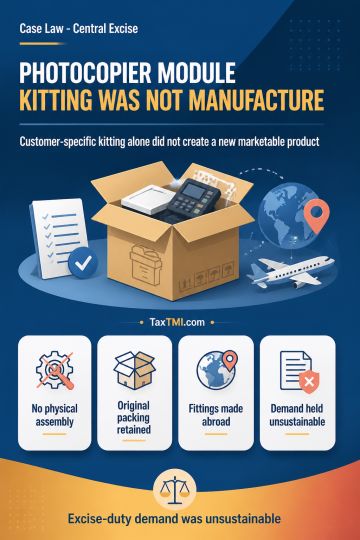
Manufacture for central excise requires transformation into a new, distinct and marketable commodity with a separate name, character and use; labour, skill, expense or value addition alone does not suffice. Kitting imported photocopier modules by unpacking and placing them into customer-specific sets was not manufacture where the components remained in original packing, no physical assembly occurred at the warehouse, and relevant fittings had been made abroad. Note 6 to Section XVI could not deem manufacture because the modules were imported and assessed as complete machines, with no subsequent conversion of incomplete goods into complete articles. Rule 2(a) governs classification only and does not determine manufacture. The excise-duty demand was unsustainable.
Manufacture for central excise requires transformation into a new, distinct and marketable commodity with a separate name, character and use; labour, skill, expense or value addition alone does not suffice. Kitting imported photocopier modules by unpacking and placing them into customer-specific sets was not manufacture where the components remained in original packing, no physical assembly occurred at the warehouse, and relevant fittings had been made abroad. Note 6 to Section XVI could not deem manufacture because the modules were imported and assessed as complete machines, with no subsequent conversion of incomplete goods into complete articles. Rule 2(a) governs classification only and does not determine manufacture. The excise-duty demand was unsustainable.
Note: It is a system-generated summary and is for quick reference only.
 TaxTMI
 of 4798



















 Join Channel


 TaxTMI
