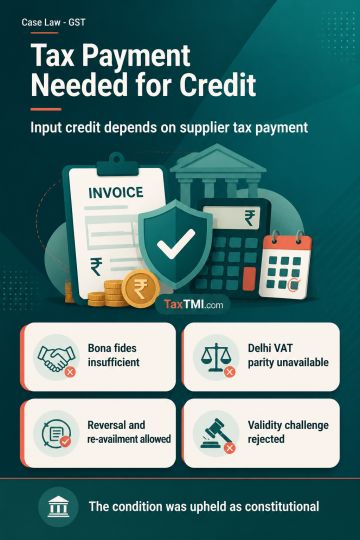
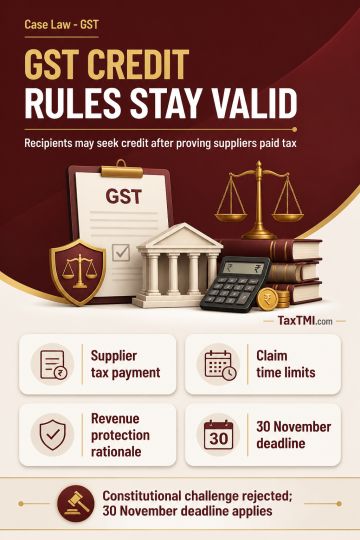
Input tax credit conditions remain constitutionally valid, with eligible recipient claims considered under GST circulars and retrospective filing dead...
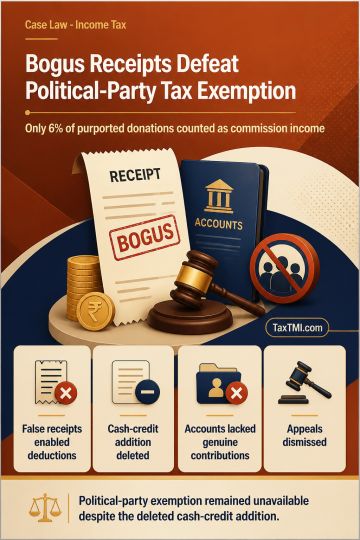
Bogus donation receipts justified commission income assessment and defeated political-party tax exemption for inaccurate accounts and reporting failur...
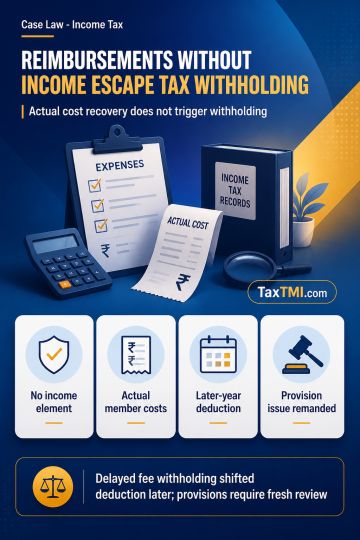
Pure reimbursement without income element escapes tax withholding, while delayed withholding and unsupported provisions face deferred or renewed scrut...
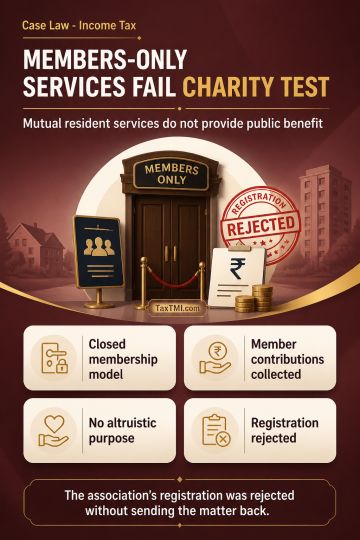
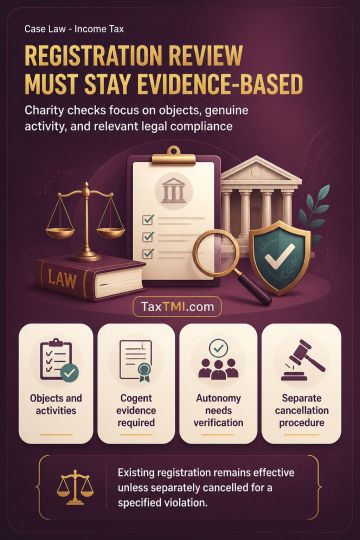
Public benefit requirement defeats charitable registration where residents' association services are reciprocal, member-only facilities governed by mu...
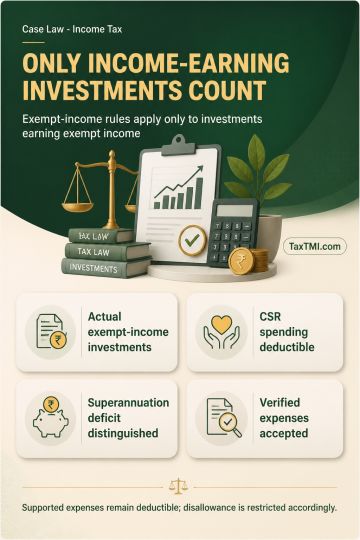
Exempt-income expenditure disallowance is confined to investments that actually generated exempt income, while supported business expenses remain dedu...
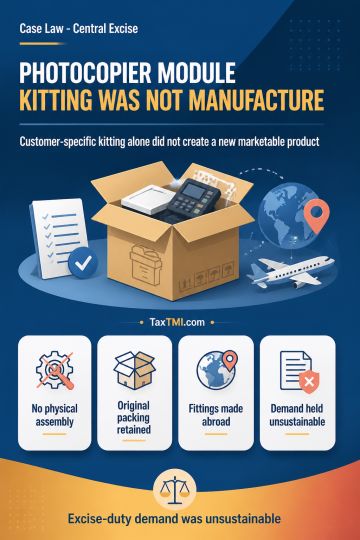
Manufacture for central excise requires transformation into a new, distinct and marketable commodity with a separate name, character and use; labour, skill, expense or value addition alone does not suffice. Kitting imported photocopier modules by unpacking and placing them into customer-specific sets was not manufacture where the components remained in original packing, no physical assembly occurred at the warehouse, and relevant fittings had been made abroad. Note 6 to Section XVI could not deem manufacture because the modules were imported and assessed as complete machines, with no subsequent conversion of incomplete goods into complete articles. Rule 2(a) governs classification only and does not determine manufacture. The excise-duty demand was unsustainable.
Manufacture for central excise requires transformation into a new, distinct and marketable commodity with a separate name, character and use; labour, skill, expense or value addition alone does not suffice. Kitting imported photocopier modules by unpacking and placing them into customer-specific sets was not manufacture where the components remained in original packing, no physical assembly occurred at the warehouse, and relevant fittings had been made abroad. Note 6 to Section XVI could not deem manufacture because the modules were imported and assessed as complete machines, with no subsequent conversion of incomplete goods into complete articles. Rule 2(a) governs classification only and does not determine manufacture. The excise-duty demand was unsustainable.
Note: It is a system-generated summary and is for quick reference only.
 TaxTMI
 of 4782






 Join Channel


 TaxTMI