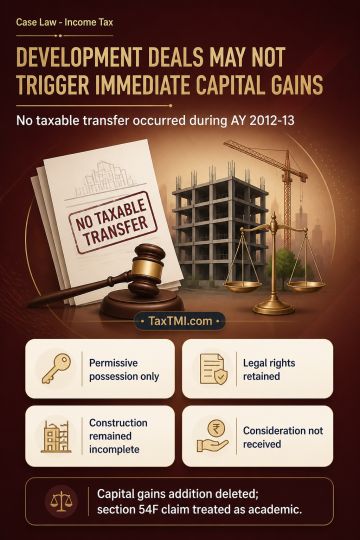
Development agreements require legal possession or effective enjoyment for capital gains transfer; permissive possession and deferred consideration de...
Prolonged sterilisation of development rights supports capital-gains treatment, while business-income disallowances cannot govern capital-gains comput...
Additional evidence in transfer pricing dispute leads to fresh examination, while tax deductions, TDS credit, fee and refund interest require verifica...
Category II AIF pass-through taxation preserves non-business income character; investment receipts cannot be reclassified without applying recognised ...
CGST Zones must establish structured coordination with State...
Mining-law intelligence sharing must support GST scrutiny, enforcement action, inter-agency dissemination, and periodic operational coordination across CGST Zones.
Contents
Summary
Note
Bookmark
Share
✓ Copied successfully !
Print
Print Options
For full text, please login
Login to TaxTMI
Verification Pending
The Email Id has not been verified. Click on the link we have sent on
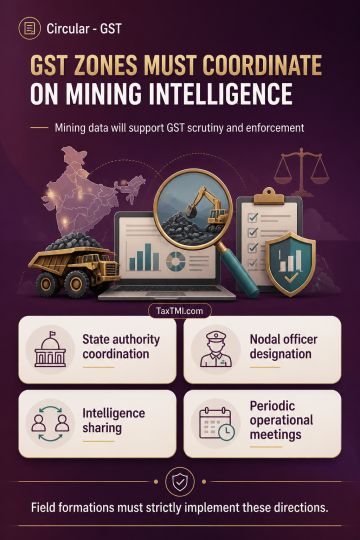
CGST Zones must establish structured coordination with State Mining Authorities to obtain periodic information on illegal mining, mineral transportation, seizures, lease violations and excess extraction. Each Zone must designate a nodal officer, analyse received intelligence for possible suppression of taxable supplies, non-registration, undervaluation, tax short payment, wrongful input tax credit and other GST violations, and initiate action where warranted under the CGST Act and rules. Relevant intelligence must be shared with jurisdictional Commissionerates or DGGI formations, and periodic meetings must review the mechanism and resolve operational issues. Field formations must circulate and strictly implement these directions.
CGST Zones must establish structured coordination with State Mining Authorities to obtain periodic information on illegal mining, mineral transportation, seizures, lease violations and excess extraction. Each Zone must designate a nodal officer, analyse received intelligence for possible suppression of taxable supplies, non-registration, undervaluation, tax short payment, wrongful input tax credit and other GST violations, and initiate action where warranted under the CGST Act and rules. Relevant intelligence must be shared with jurisdictional Commissionerates or DGGI formations, and periodic meetings must review the mechanism and resolve operational issues. Field formations must circulate and strictly implement these directions.
Note: It is a system-generated summary and is for quick reference only.
 TaxTMI
 of 4805















 Join Channel


 TaxTMI
