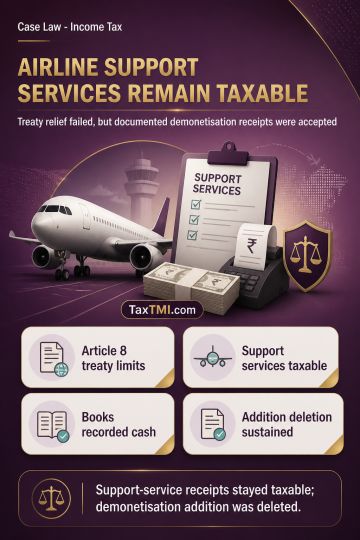
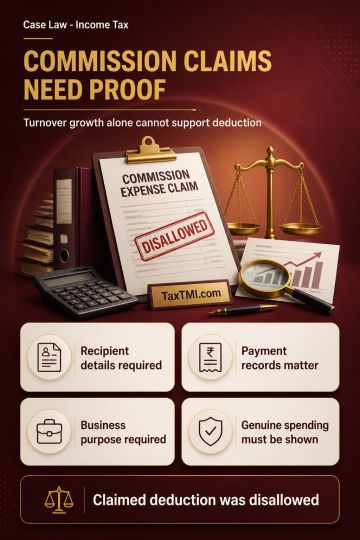
Business expenditure deduction requires proof of genuine commission payments and commercial allowability; turnover growth alone cannot validate the cl...
Article 8 treaty coverage excluded third-party airline support services, while documented demonetisation cash receipts remained accepted business inco...
Page of 4778
Press 'Enter' after typing page number.
81 to 100 of 95557 Results
❮
❯
❯❯
0 / 200
Expand Note
Add to Folder
No Folders have been created
+
Are you sure you want to delete "My most important" ?
Transfer pricing of low-end IT-enabled back-office support...
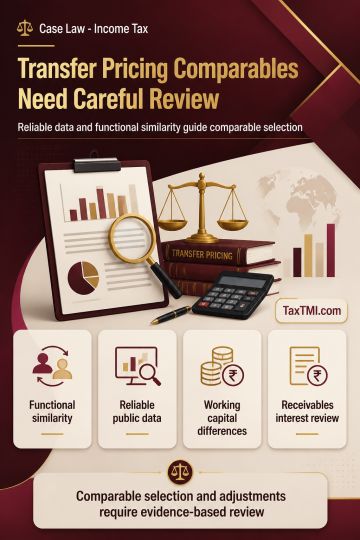
Transfer pricing comparability requires functional alignment, reliable financial data, and careful review of working capital and receivables adjustments.
Contents
Summary
Note
Bookmark
Share
✓ Copied successfully !
Print
Print Options
For full text, please login
Login to TaxTMI
Verification Pending
The Email Id has not been verified. Click on the link we have sent on
Transfer pricing of low-end IT-enabled back-office support services requires functional comparability and reliable public financial data. Comparable companies may be included where their accounting, human-resources or BPO functions are broadly similar, but excluded for unavailable data, abnormal royalty-driven profits, high-end consultancy or audit functions, or unsegregated merger effects. Working capital adjustment requires examination of demonstrated differences in collection periods between the tested party and comparables. Interest on outstanding associated-enterprise receivables requires review of the taxpayer's debt-free status and whether its average collection period is abnormally high against industry practice; denial of working capital adjustment should not coexist with an unexamined receivables interest adjustment.
Transfer pricing of low-end IT-enabled back-office support services requires functional comparability and reliable public financial data. Comparable companies may be included where their accounting, human-resources or BPO functions are broadly similar, but excluded for unavailable data, abnormal royalty-driven profits, high-end consultancy or audit functions, or unsegregated merger effects. Working capital adjustment requires examination of demonstrated differences in collection periods between the tested party and comparables. Interest on outstanding associated-enterprise receivables requires review of the taxpayer's debt-free status and whether its average collection period is abnormally high against industry practice; denial of working capital adjustment should not coexist with an unexamined receivables interest adjustment.
Note: It is a system-generated summary and is for quick reference only.
 TaxTMI
 of 4778





 Join Channel


 TaxTMI