Section 80P deduction covers Souharda credit societies, including qualifying surplus-deposit interest, subject to member KYC verification for cash dep...
Transfer-pricing benchmarking and capital-receipt principles sustained taxpayer relief, while unsupported property-advance write-offs remained disallo...
Sugar export prohibition applied prospectively under the policy...
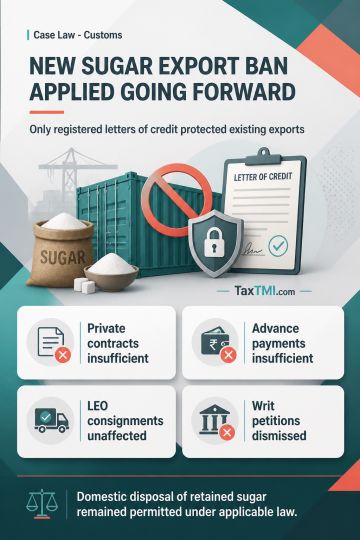
Prospective sugar export prohibition required registered letters of credit; private contracts and export quotas created no enforceable continuation right.
Contents
Summary
Note
Bookmark
Share
✓ Copied successfully !
Print
Print Options
For full text, please login
Login to TaxTMI
Verification Pending
The Email Id has not been verified. Click on the link we have sent on
Sugar export prohibition applied prospectively under the policy prevailing on the export date. Transitional protection required a pre-existing, registered irrevocable commercial letter of credit; private contracts, advance payments, and unsubstantiated claims that goods were in the export pipeline did not qualify. Consignments covered by a Let Export Order issued before the notification remained unaffected. The article notes that export quotas did not create vested rights for merchant exporters, and legitimate expectation or promissory estoppel could not prevent a revised policy adopted in supervening public interest. The prohibition, intended to protect domestic availability and price stability, was treated as a reasonable restriction; the writ petitions were dismissed, with domestic disposal of retained sugar permitted under applicable law.
Sugar export prohibition applied prospectively under the policy prevailing on the export date. Transitional protection required a pre-existing, registered irrevocable commercial letter of credit; private contracts, advance payments, and unsubstantiated claims that goods were in the export pipeline did not qualify. Consignments covered by a Let Export Order issued before the notification remained unaffected. The article notes that export quotas did not create vested rights for merchant exporters, and legitimate expectation or promissory estoppel could not prevent a revised policy adopted in supervening public interest. The prohibition, intended to protect domestic availability and price stability, was treated as a reasonable restriction; the writ petitions were dismissed, with domestic disposal of retained sugar permitted under applicable law.
Note: It is a system-generated summary and is for quick reference only.
 TaxTMI
 of 4782


















 Join Channel


 TaxTMI