Development agreements require legal possession or effective enjoyment for capital gains transfer; permissive possession and deferred consideration de...
Prolonged sterilisation of development rights supports capital-gains treatment, while business-income disallowances cannot govern capital-gains comput...
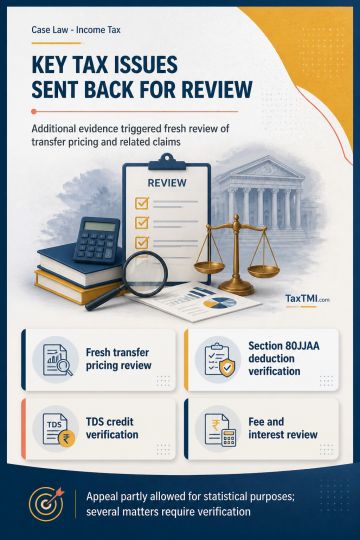
Additional evidence in transfer pricing dispute leads to fresh examination, while tax deductions, TDS credit, fee and refund interest require verifica...
Category II AIF pass-through taxation preserves non-business income character; investment receipts cannot be reclassified without applying recognised ...
Mutual fund maturity rules require proper rollover, redemption, disclosure, and due diligence; investor gains cannot excuse regulatory breaches or pen...
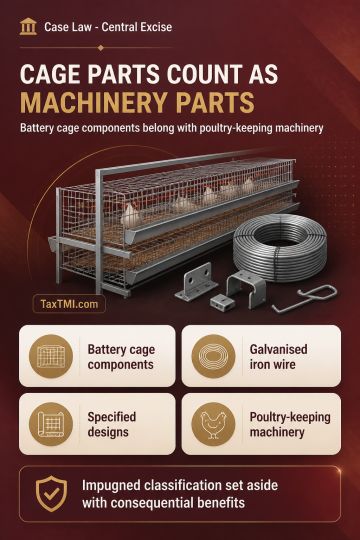
Welded mesh top, side, bottom, door and centre components made from galvanised iron wire exclusively for poultry battery cages are discussed as classifiable under CETH 84369100 as parts of poultry-keeping machinery, rather than under CETH 73089090 as iron and steel structures or parts. The material described the components as manufactured to specified designs and identifiable solely for battery cages. It notes that the absence of a mechanical function in the assembled cage did not establish classification as structural goods, and that reliance on the cited Supreme Court order was misplaced because the subsequent appellate decision accepted the machinery-parts classification. The impugned classification was set aside with consequential benefits.
Welded mesh top, side, bottom, door and centre components made from galvanised iron wire exclusively for poultry battery cages are discussed as classifiable under CETH 84369100 as parts of poultry-keeping machinery, rather than under CETH 73089090 as iron and steel structures or parts. The material described the components as manufactured to specified designs and identifiable solely for battery cages. It notes that the absence of a mechanical function in the assembled cage did not establish classification as structural goods, and that reliance on the cited Supreme Court order was misplaced because the subsequent appellate decision accepted the machinery-parts classification. The impugned classification was set aside with consequential benefits.
Note: It is a system-generated summary and is for quick reference only.
 TaxTMI
 of 4798



















 Join Channel


 TaxTMI
