Retrospective cancellation of charitable registration under section 12AB(4) was unsustainable; related-party benefit allegations did not prove nongenu...
Merger control notice and disclosure rules: Supreme Court limits penalties, rejects reopening of approved combination, and sets aside adverse findings...
Page of 4807
Press 'Enter' after typing page number.
2741 to 2760 of 96140 Results
❮
❯
❯❯
0 / 200
Expand Note
Add to Folder
No Folders have been created
+
Are you sure you want to delete "My most important" ?
Business promotion expenditure claimed as commission or...
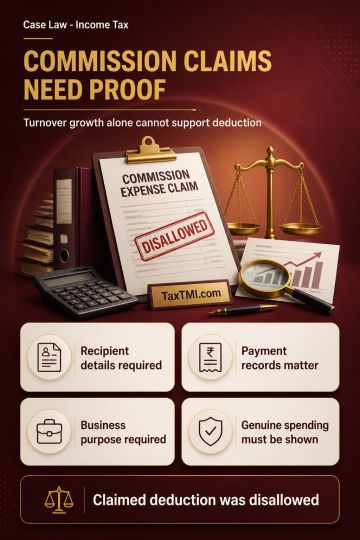
Business expenditure deduction requires proof of genuine commission payments and commercial allowability; turnover growth alone cannot validate the claim.
Contents
Summary
Note
Bookmark
Share
✓ Copied successfully !
Print
Print Options
For full text, please login
Login to TaxTMI
Verification Pending
The Email Id has not been verified. Click on the link we have sent on
Business promotion expenditure claimed as commission or incentive payments is deductible under section 37(1) only when the taxpayer proves its nature, actual incurrence and business allowability with adequate particulars and supporting evidence. The article notes that failure to provide recipient details, payment amounts, dates, modes of payment or documentary support defeats the claim. Increased turnover alone does not establish compliance with the statutory requirements. The disallowance rested on the unproven genuineness and allowability of the expenditure, rather than solely on recipients being private persons instead of public servants; the claimed deduction was therefore disallowed.
Business promotion expenditure claimed as commission or incentive payments is deductible under section 37(1) only when the taxpayer proves its nature, actual incurrence and business allowability with adequate particulars and supporting evidence. The article notes that failure to provide recipient details, payment amounts, dates, modes of payment or documentary support defeats the claim. Increased turnover alone does not establish compliance with the statutory requirements. The disallowance rested on the unproven genuineness and allowability of the expenditure, rather than solely on recipients being private persons instead of public servants; the claimed deduction was therefore disallowed.
Note: It is a system-generated summary and is for quick reference only.
 TaxTMI
  TaxTMI
 of 4807


 Join Channel