Specified income of Baddi Barotiwala Nalagarh Development Authority receives conditional tax exemption, retrospectively covering its designated assess...
Specified development authority income receives retrospective tax exemption, subject to non-commercial activity, unchanged income sources, and return-...
Unified Brand India framework introduces voluntary Trust Mark certification and funding support for export branding, packaging and global promotional ...
Origin Declaration authentication governs preferential tariff claims under India-UK CETA, requiring a validated reference number before import clearan...
Separate assessment orders for different years remain valid when distinct notices and hearing opportunities prevent prejudice from combined proceeding...
Magnesium bis-glycinate chelate is classified by its objective...
Objective characteristics govern magnesium bis-glycinate chelate classification as an amino-acid coordination compound, not a food preparation or antibiotic.
Contents
Summary
Note
Bookmark
Share
✓ Copied successfully !
Print
Print Options
For full text, please login
Login to TaxTMI
Verification Pending
The Email Id has not been verified. Click on the link we have sent on
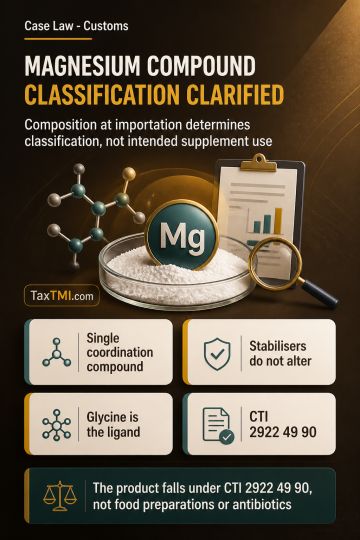
Magnesium bis-glycinate chelate is classified by its objective characteristics and composition at importation, rather than its intended use in nutritional supplements. As a single chemically defined coordination compound, it remains within Chapter 29; water and citric acid used solely as stabilisers do not alter that treatment. Applying the Chapter Note for coordination compounds, classification follows the organic ligand obtained on cleavage of the metal bond. As the ligand is glycine, an amino acid, the product falls under CTI 2922 49 90 as other amino acids and their esters; salts thereof, and not under food preparations or antibiotics.
Magnesium bis-glycinate chelate is classified by its objective characteristics and composition at importation, rather than its intended use in nutritional supplements. As a single chemically defined coordination compound, it remains within Chapter 29; water and citric acid used solely as stabilisers do not alter that treatment. Applying the Chapter Note for coordination compounds, classification follows the organic ligand obtained on cleavage of the metal bond. As the ligand is glycine, an amino acid, the product falls under CTI 2922 49 90 as other amino acids and their esters; salts thereof, and not under food preparations or antibiotics.
Note: It is a system-generated summary and is for quick reference only.
 TaxTMI
 of 4794






















 Join Channel


 TaxTMI

