Approved resolution plans extinguish unsubmitted pre-approval tax claims, preventing later recovery outside the insolvency process and preserving a cl...
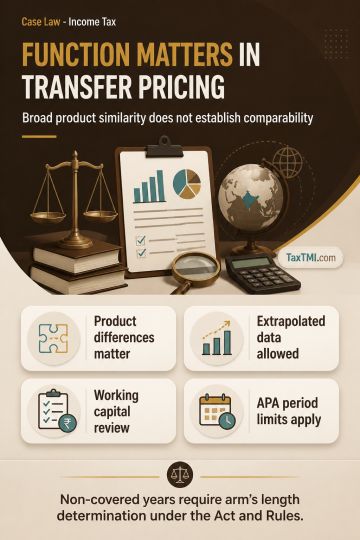
Transfer pricing comparability requires functional alignment and permits working capital adjustment, while APA margins cannot govern non-covered years...
Treaty benefit, goodwill depreciation and hedging costs: export commission disallowed, while key business deductions and depreciation claims succeeded...
Undisclosed foreign asset classification requires an unexplained source; unrebutted affidavits and corroborative evidence defeated the Black Money Act...
Page of 4788
Press 'Enter' after typing page number.
641 to 660 of 95749 Results
❮
❯
❯❯
0 / 200
Expand Note
Add to Folder
No Folders have been created
+
Are you sure you want to delete "My most important" ?
Magnesium bis-glycinate chelate is classified by its objective...
Objective characteristics govern magnesium bis-glycinate chelate classification as an amino-acid coordination compound, not a food preparation or antibiotic.
Contents
Summary
Note
Bookmark
Share
✓ Copied successfully !
Print
Print Options
For full text, please login
Login to TaxTMI
Verification Pending
The Email Id has not been verified. Click on the link we have sent on
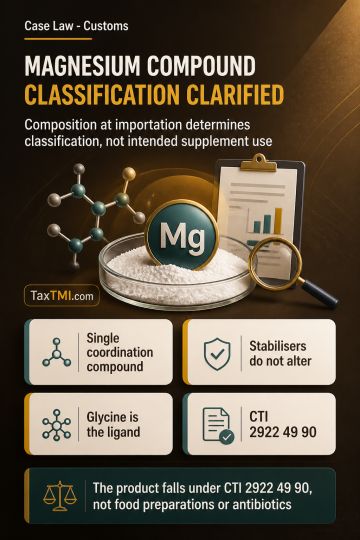
Magnesium bis-glycinate chelate is classified by its objective characteristics and composition at importation, rather than its intended use in nutritional supplements. As a single chemically defined coordination compound, it remains within Chapter 29; water and citric acid used solely as stabilisers do not alter that treatment. Applying the Chapter Note for coordination compounds, classification follows the organic ligand obtained on cleavage of the metal bond. As the ligand is glycine, an amino acid, the product falls under CTI 2922 49 90 as other amino acids and their esters; salts thereof, and not under food preparations or antibiotics.
Magnesium bis-glycinate chelate is classified by its objective characteristics and composition at importation, rather than its intended use in nutritional supplements. As a single chemically defined coordination compound, it remains within Chapter 29; water and citric acid used solely as stabilisers do not alter that treatment. Applying the Chapter Note for coordination compounds, classification follows the organic ligand obtained on cleavage of the metal bond. As the ligand is glycine, an amino acid, the product falls under CTI 2922 49 90 as other amino acids and their esters; salts thereof, and not under food preparations or antibiotics.
Note: It is a system-generated summary and is for quick reference only.
 TaxTMI
 of 4788


















 Join Channel


 TaxTMI