Inherited property sale proceeds require capital-gains treatment where ownership is supported by evidence, not suspicion or unverified signature doubt...
Cross-examination of retracted statements is essential where foundational evidence supports a benami allegation and documented funding explanations re...
Capital-goods exemption covers plant-modernisation accessories, while the import restriction applies only to earlier capital-goods components and spar...
Constitutional judicial review permits challenges to ECIRs and connected money-laundering proceedings where coercive action affects fundamental intere...
Magnesium bis-glycinate chelate is classified by its objective...
Objective characteristics govern magnesium bis-glycinate chelate classification as an amino-acid coordination compound, not a food preparation or antibiotic.
Contents
Summary
Note
Bookmark
Share
✓ Copied successfully !
Print
Print Options
For full text, please login
Login to TaxTMI
Verification Pending
The Email Id has not been verified. Click on the link we have sent on
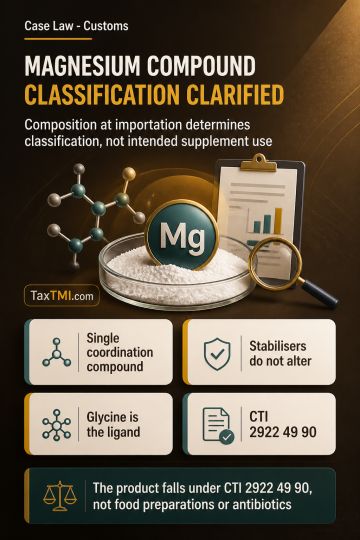
Magnesium bis-glycinate chelate is classified by its objective characteristics and composition at importation, rather than its intended use in nutritional supplements. As a single chemically defined coordination compound, it remains within Chapter 29; water and citric acid used solely as stabilisers do not alter that treatment. Applying the Chapter Note for coordination compounds, classification follows the organic ligand obtained on cleavage of the metal bond. As the ligand is glycine, an amino acid, the product falls under CTI 2922 49 90 as other amino acids and their esters; salts thereof, and not under food preparations or antibiotics.
Magnesium bis-glycinate chelate is classified by its objective characteristics and composition at importation, rather than its intended use in nutritional supplements. As a single chemically defined coordination compound, it remains within Chapter 29; water and citric acid used solely as stabilisers do not alter that treatment. Applying the Chapter Note for coordination compounds, classification follows the organic ligand obtained on cleavage of the metal bond. As the ligand is glycine, an amino acid, the product falls under CTI 2922 49 90 as other amino acids and their esters; salts thereof, and not under food preparations or antibiotics.
Note: It is a system-generated summary and is for quick reference only.
 TaxTMI
 of 4780






















 Join Channel


 TaxTMI