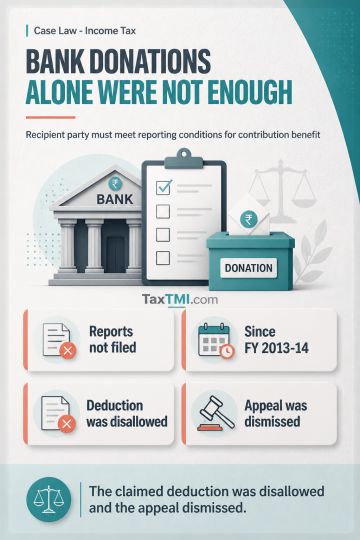
Political contribution deductions require recipient party compliance with contribution-reporting conditions; banking-channel donations alone do not qu...
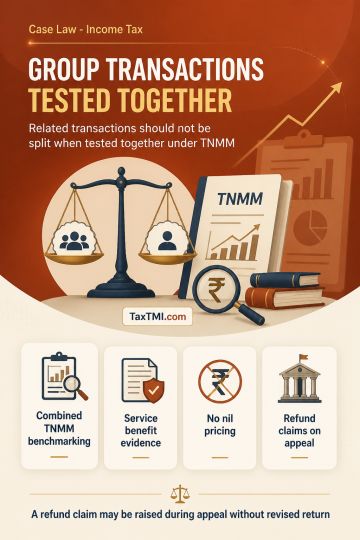
Aggregation under TNMM prevents selective testing of intra-group services without comparable uncontrolled transactions, while appellate additional cla...
Protective assessment cannot duplicate identical receipts under competing characterisations; remote services did not establish a taxable permanent est...
Current account treatment of overseas tournament services removed most FEMA findings, but excess EEFC remittance and delayed repatriation remained bre...
Modification of bail conditions remains available through inherent jurisdiction where onerous deposits undermine justice and cannot recover disputed d...
Merchant banker regulation consolidates registration, governance, capital, reporting, outsourcing and investor-protection requirements under an update...
Magnesium bis-glycinate chelate is classified by its objective...
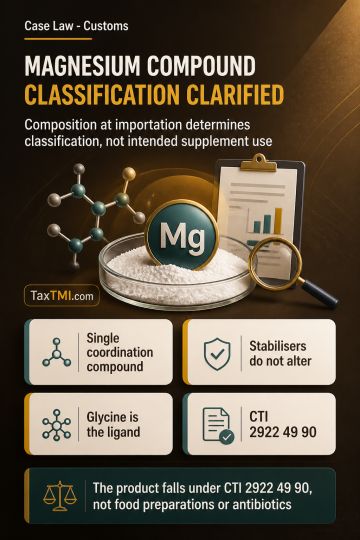
Objective characteristics govern magnesium bis-glycinate chelate classification as an amino-acid coordination compound, not a food preparation or antibiotic.
Contents
Summary
Note
Bookmark
Share
✓ Copied successfully !
Print
Print Options
For full text, please login
Login to TaxTMI
Verification Pending
The Email Id has not been verified. Click on the link we have sent on
Magnesium bis-glycinate chelate is classified by its objective characteristics and composition at importation, rather than its intended use in nutritional supplements. As a single chemically defined coordination compound, it remains within Chapter 29; water and citric acid used solely as stabilisers do not alter that treatment. Applying the Chapter Note for coordination compounds, classification follows the organic ligand obtained on cleavage of the metal bond. As the ligand is glycine, an amino acid, the product falls under CTI 2922 49 90 as other amino acids and their esters; salts thereof, and not under food preparations or antibiotics.
Magnesium bis-glycinate chelate is classified by its objective characteristics and composition at importation, rather than its intended use in nutritional supplements. As a single chemically defined coordination compound, it remains within Chapter 29; water and citric acid used solely as stabilisers do not alter that treatment. Applying the Chapter Note for coordination compounds, classification follows the organic ligand obtained on cleavage of the metal bond. As the ligand is glycine, an amino acid, the product falls under CTI 2922 49 90 as other amino acids and their esters; salts thereof, and not under food preparations or antibiotics.
Note: It is a system-generated summary and is for quick reference only.
 TaxTMI
 of 4780
















 Join Channel


 TaxTMI