Customs Broker association membership becomes mandatory in the operating jurisdiction, with exclusive membership and limited compliance-time relaxatio...
Prospective sugar export prohibition required registered letters of credit; private contracts and export quotas created no enforceable continuation ri...
Objective characteristics govern magnesium bis-glycinate chelate classification as an amino-acid coordination compound, not a food preparation or anti...
Opportunity to respond to jurisdictional reports is mandatory before customs settlement duty enhancement; connected applications require consistent ad...
Page of 62
Press 'Enter' after typing page number.
1 to 20 of 1229 Results
❮
❯
❯❯
0 / 200
Expand Note
Add to Folder
No Folders have been created
+
Are you sure you want to delete "My most important" ?
Magnesium bis-glycinate chelate is classified by its objective...
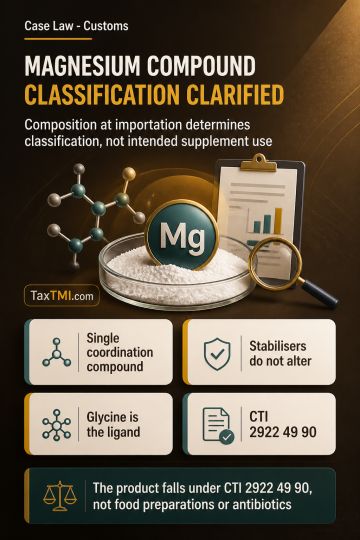
Objective characteristics govern magnesium bis-glycinate chelate classification as an amino-acid coordination compound, not a food preparation or antibiotic.
Contents
Summary
Note
Bookmark
Share
✓ Copied successfully !
Print
Print Options
For full text, please login
Login to TaxTMI
Verification Pending
The Email Id has not been verified. Click on the link we have sent on
Magnesium bis-glycinate chelate is classified by its objective characteristics and composition at importation, rather than its intended use in nutritional supplements. As a single chemically defined coordination compound, it remains within Chapter 29; water and citric acid used solely as stabilisers do not alter that treatment. Applying the Chapter Note for coordination compounds, classification follows the organic ligand obtained on cleavage of the metal bond. As the ligand is glycine, an amino acid, the product falls under CTI 2922 49 90 as other amino acids and their esters; salts thereof, and not under food preparations or antibiotics.
Magnesium bis-glycinate chelate is classified by its objective characteristics and composition at importation, rather than its intended use in nutritional supplements. As a single chemically defined coordination compound, it remains within Chapter 29; water and citric acid used solely as stabilisers do not alter that treatment. Applying the Chapter Note for coordination compounds, classification follows the organic ligand obtained on cleavage of the metal bond. As the ligand is glycine, an amino acid, the product falls under CTI 2922 49 90 as other amino acids and their esters; salts thereof, and not under food preparations or antibiotics.
Note: It is a system-generated summary and is for quick reference only.
 TaxTMI



















 Join Channel


 TaxTMI