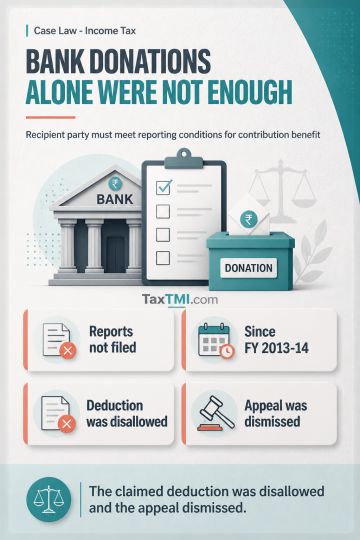
Political contribution deductions require recipient party compliance with contribution-reporting conditions; banking-channel donations alone do not qu...
Aggregation under TNMM prevents selective testing of intra-group services without comparable uncontrolled transactions, while appellate additional cla...
Protective assessment cannot duplicate identical receipts under competing characterisations; remote services did not establish a taxable permanent est...
Current account treatment of overseas tournament services removed most FEMA findings, but excess EEFC remittance and delayed repatriation remained bre...
Modification of bail conditions remains available through inherent jurisdiction where onerous deposits undermine justice and cannot recover disputed d...
Merchant banker regulation consolidates registration, governance, capital, reporting, outsourcing and investor-protection requirements under an update...
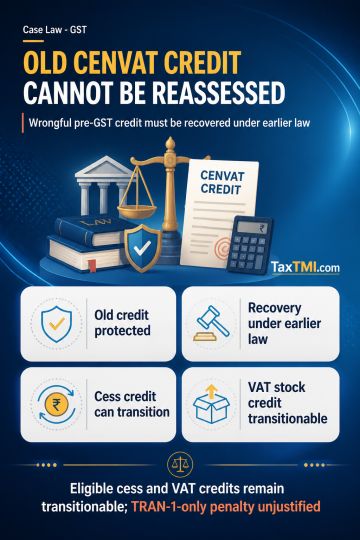
Transitional CENVAT credit reflected as an undisputed closing balance under the erstwhile service tax regime cannot be reassessed or denied through CGST proceedings merely because its original availment is alleged to have been inadmissible. The notes explain that recovery for wrongful pre-GST CENVAT credit must proceed under the saved provisions of the erstwhile law, not under the CGST Act. They further address transition of Krishi Kalyan Cess credit through TRAN-1, noting the relevance of unoperationalised transitional explanations and applicable High Court guidance. VAT credit on stock-in-trade is described as transitionable where required particulars were furnished and no specific adverse material supports denial. Penalty based solely on TRAN-1 disclosures is also treated as unjustified.
Transitional CENVAT credit reflected as an undisputed closing balance under the erstwhile service tax regime cannot be reassessed or denied through CGST proceedings merely because its original availment is alleged to have been inadmissible. The notes explain that recovery for wrongful pre-GST CENVAT credit must proceed under the saved provisions of the erstwhile law, not under the CGST Act. They further address transition of Krishi Kalyan Cess credit through TRAN-1, noting the relevance of unoperationalised transitional explanations and applicable High Court guidance. VAT credit on stock-in-trade is described as transitionable where required particulars were furnished and no specific adverse material supports denial. Penalty based solely on TRAN-1 disclosures is also treated as unjustified.
Note: It is a system-generated summary and is for quick reference only.
 TaxTMI
 of 4780



















 Join Channel


 TaxTMI