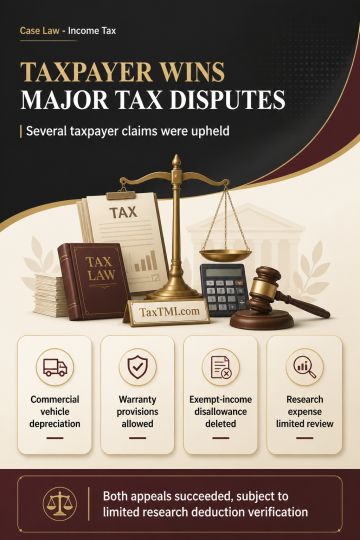
Commercial vehicle depreciation, scientifically determined warranty provisions and exempt-income disallowances were resolved in favour of the taxpayer...
Inherited property sale proceeds require capital-gains treatment where ownership is supported by evidence, not suspicion or unverified signature doubt...
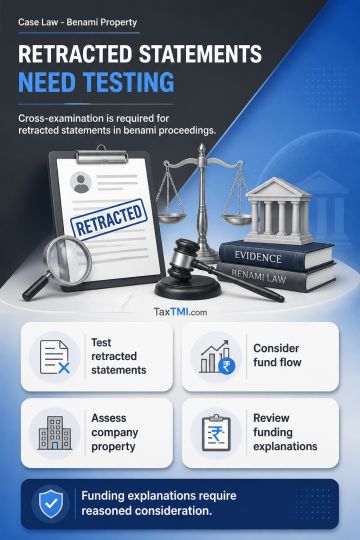
Cross-examination of retracted statements is essential where foundational evidence supports a benami allegation and documented funding explanations re...
Capital-goods exemption covers plant-modernisation accessories, while the import restriction applies only to earlier capital-goods components and spar...
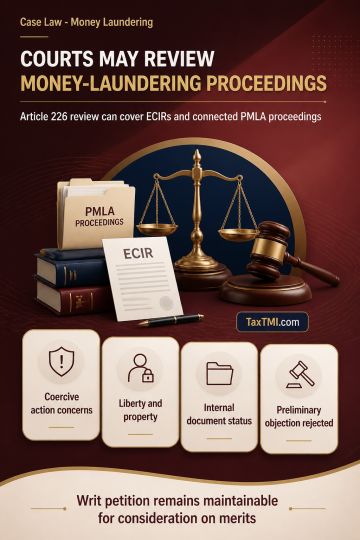
Constitutional judicial review permits challenges to ECIRs and connected money-laundering proceedings where coercive action affects fundamental intere...
Section 127C(5) requires the Settlement Commission to provide a...
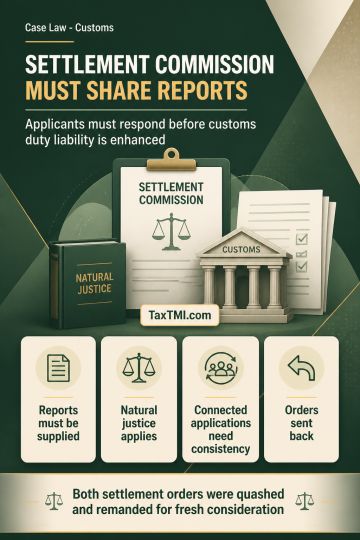
Opportunity to respond to jurisdictional reports is mandatory before customs settlement duty enhancement; connected applications require consistent adjudication.
Contents
Summary
Note
Bookmark
Share
✓ Copied successfully !
Print
Print Options
For full text, please login
Login to TaxTMI
Verification Pending
The Email Id has not been verified. Click on the link we have sent on
Section 127C(5) requires the Settlement Commission to provide a settlement applicant an opportunity to address a jurisdictional Commissioner's report before relying on it to enhance customs duty liability. Non-supply of the report breached that statutory requirement and principles of natural justice, requiring the settlement order to be quashed and remanded for fresh consideration. Separate settlement applications arising from the same seized imported goods were intrinsically connected and required a consistent approach. The differing treatment of the Revenue report lacked a discernible basis; therefore, the related subsequent order was also quashed and remanded, with all merits left open.
Section 127C(5) requires the Settlement Commission to provide a settlement applicant an opportunity to address a jurisdictional Commissioner's report before relying on it to enhance customs duty liability. Non-supply of the report breached that statutory requirement and principles of natural justice, requiring the settlement order to be quashed and remanded for fresh consideration. Separate settlement applications arising from the same seized imported goods were intrinsically connected and required a consistent approach. The differing treatment of the Revenue report lacked a discernible basis; therefore, the related subsequent order was also quashed and remanded, with all merits left open.
Note: It is a system-generated summary and is for quick reference only.
 TaxTMI
 of 4780







 Join Channel


 TaxTMI
