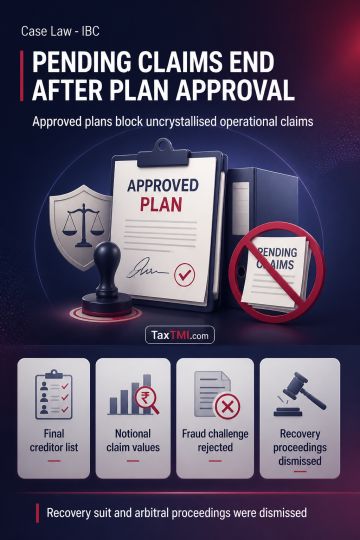
Clean slate principle extinguishes uncrystallised operational claims and bars continuation of pending recovery and arbitral proceedings after plan app...
Works contract classification governs composite layout-development contracts where VAT-paid goods are transferred alongside construction and infrastru...
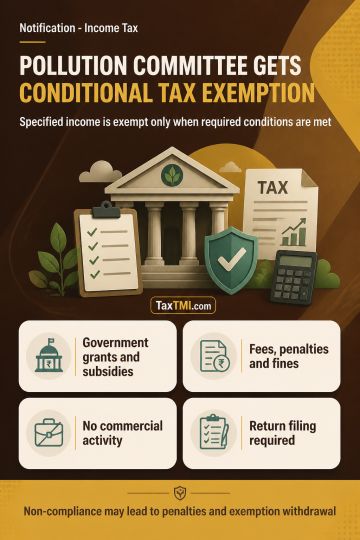
Specified income tax exemption for pollution control body remains conditional on non-commercial activity, unchanged income character, and return filin...
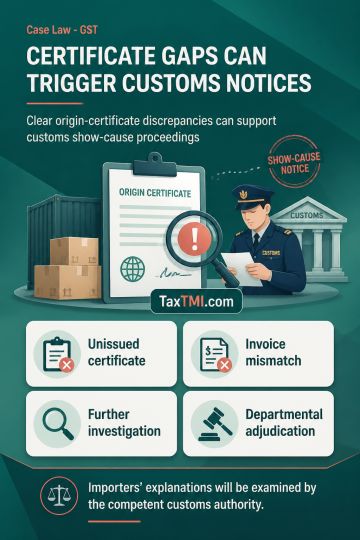
Jurisdictional facts in certificate-of-origin discrepancies can support customs show-cause proceedings, leaving factual explanations for departmental ...
Derivative penal liability for abetment of improper importation...
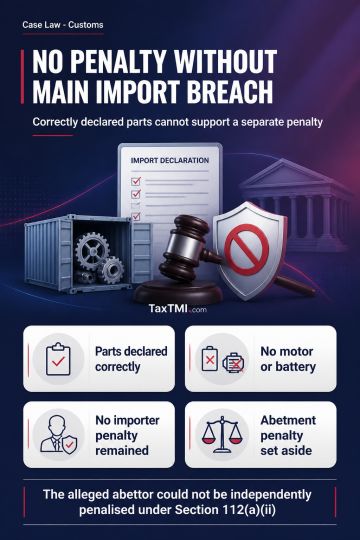
Derivative abetment liability fails when correctly declared imported components establish no underlying improper importation by the principal importer.
Contents
Summary
Note
Bookmark
Share
✓ Copied successfully !
Print
Print Options
For full text, please login
Login to TaxTMI
Verification Pending
The Email Id has not been verified. Click on the link we have sent on
Derivative penal liability for abetment of improper importation cannot survive where the alleged principal contravention fails. The imported components, lacking an electric motor and battery, did not have the essential character of complete electrical tricycles under Rule 2(a) of the General Rules for Interpretation and were correctly declared as parts/components. As no misdeclaration, confiscation, differential duty, or penalty remained against the importer, the alleged abettor could not be independently penalised under Section 112(a)(ii) of the Customs Act. The reported outcome was that the abetment penalty was set aside, while an alternative contention was not examined.
Derivative penal liability for abetment of improper importation cannot survive where the alleged principal contravention fails. The imported components, lacking an electric motor and battery, did not have the essential character of complete electrical tricycles under Rule 2(a) of the General Rules for Interpretation and were correctly declared as parts/components. As no misdeclaration, confiscation, differential duty, or penalty remained against the importer, the alleged abettor could not be independently penalised under Section 112(a)(ii) of the Customs Act. The reported outcome was that the abetment penalty was set aside, while an alternative contention was not examined.
Note: It is a system-generated summary and is for quick reference only.
 TaxTMI
 of 4790












 Join Channel


 TaxTMI