Approved resolution plans extinguish unsubmitted pre-approval tax claims, preventing later recovery outside the insolvency process and preserving a cl...
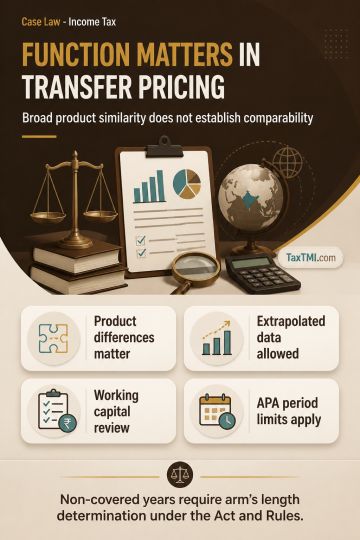
Transfer pricing comparability requires functional alignment and permits working capital adjustment, while APA margins cannot govern non-covered years...
Treaty benefit, goodwill depreciation and hedging costs: export commission disallowed, while key business deductions and depreciation claims succeeded...
Undisclosed foreign asset classification requires an unexplained source; unrebutted affidavits and corroborative evidence defeated the Black Money Act...
Page of 4787
Press 'Enter' after typing page number.
641 to 660 of 95724 Results
❮
❯
❯❯
0 / 200
Expand Note
Add to Folder
No Folders have been created
+
Are you sure you want to delete "My most important" ?
Derivative penal liability for abetment of improper importation...
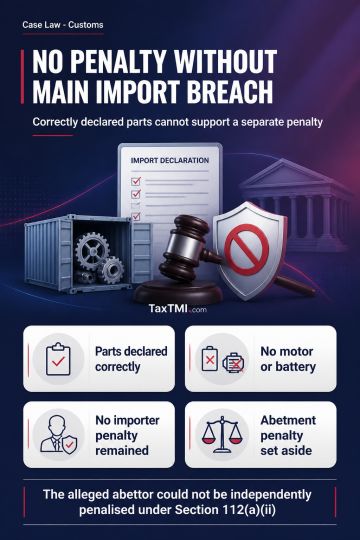
Derivative abetment liability fails when correctly declared imported components establish no underlying improper importation by the principal importer.
Contents
Summary
Note
Bookmark
Share
✓ Copied successfully !
Print
Print Options
For full text, please login
Login to TaxTMI
Verification Pending
The Email Id has not been verified. Click on the link we have sent on
Derivative penal liability for abetment of improper importation cannot survive where the alleged principal contravention fails. The imported components, lacking an electric motor and battery, did not have the essential character of complete electrical tricycles under Rule 2(a) of the General Rules for Interpretation and were correctly declared as parts/components. As no misdeclaration, confiscation, differential duty, or penalty remained against the importer, the alleged abettor could not be independently penalised under Section 112(a)(ii) of the Customs Act. The reported outcome was that the abetment penalty was set aside, while an alternative contention was not examined.
Derivative penal liability for abetment of improper importation cannot survive where the alleged principal contravention fails. The imported components, lacking an electric motor and battery, did not have the essential character of complete electrical tricycles under Rule 2(a) of the General Rules for Interpretation and were correctly declared as parts/components. As no misdeclaration, confiscation, differential duty, or penalty remained against the importer, the alleged abettor could not be independently penalised under Section 112(a)(ii) of the Customs Act. The reported outcome was that the abetment penalty was set aside, while an alternative contention was not examined.
Note: It is a system-generated summary and is for quick reference only.
 TaxTMI
 of 4787



















 Join Channel


 TaxTMI