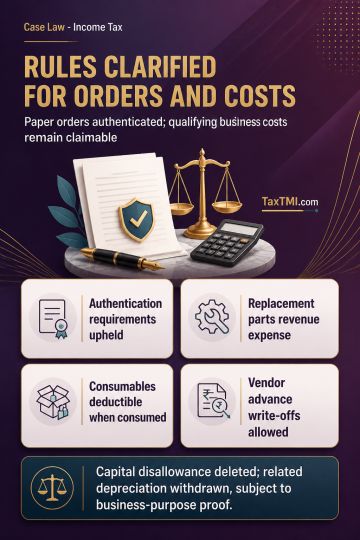
Authentication of paper assessment orders upheld, while qualifying repairs, consumables and vendor advance write-offs remain deductible business claim...
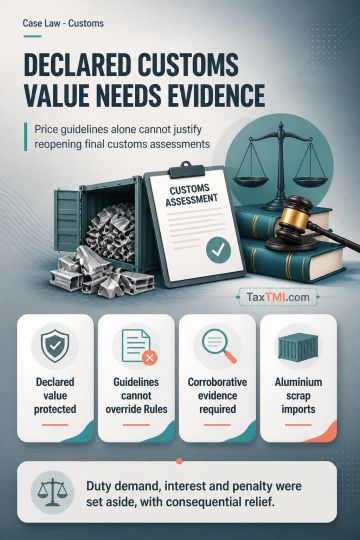
Transaction value cannot be rejected solely on non-statutory valuation guidelines without corroborative evidence supporting reassessment of final cust...
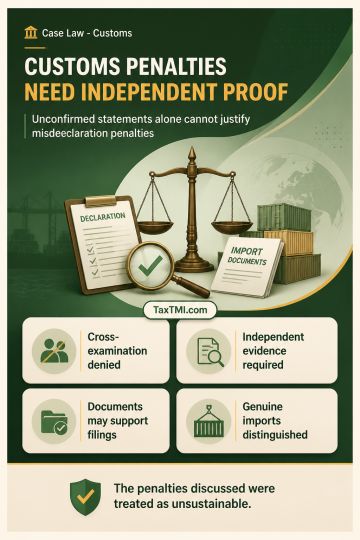
Cross-examination rights and corroborated evidence limit customs penalties for misdeclaration in genuine import transactions involving documented clea...
Page of 4780
Press 'Enter' after typing page number.
261 to 280 of 95596 Results
❮
❯
❯❯
0 / 200
Expand Note
Add to Folder
No Folders have been created
+
Are you sure you want to delete "My most important" ?
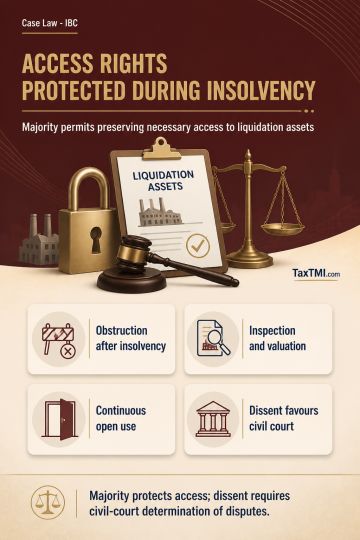
Section 60(5)(c) jurisdiction is examined in relation to a liquidator's request to protect access to a liquidation-estate asset across adjoining third-party land. The majority view treats obstruction arising after commencement of insolvency as sufficiently connected with liquidation where it impairs inspection, valuation and sale, and permits protection of a pre-existing right without creating a new one. It further addresses prescriptive easements, requiring continuous, open and peaceable use for the statutory period; recorded access and satellite imagery are discussed as supporting evidence. The dissent considers a disputed easement, including its route, dimensions and adverse use, unsuitable for summary insolvency jurisdiction and requiring civil-court determination.
Section 60(5)(c) jurisdiction is examined in relation to a liquidator's request to protect access to a liquidation-estate asset across adjoining third-party land. The majority view treats obstruction arising after commencement of insolvency as sufficiently connected with liquidation where it impairs inspection, valuation and sale, and permits protection of a pre-existing right without creating a new one. It further addresses prescriptive easements, requiring continuous, open and peaceable use for the statutory period; recorded access and satellite imagery are discussed as supporting evidence. The dissent considers a disputed easement, including its route, dimensions and adverse use, unsuitable for summary insolvency jurisdiction and requiring civil-court determination.
Note: It is a system-generated summary and is for quick reference only.
 TaxTMI
 of 4780




 Join Channel


 TaxTMI