Prolonged sterilisation of development rights supports capital-gains treatment, while business-income disallowances cannot govern capital-gains comput...
Additional evidence in transfer pricing dispute leads to fresh examination, while tax deductions, TDS credit, fee and refund interest require verifica...
Category II AIF pass-through taxation preserves non-business income character; investment receipts cannot be reclassified without applying recognised ...
Mutual fund maturity rules require proper rollover, redemption, disclosure, and due diligence; investor gains cannot excuse regulatory breaches or pen...
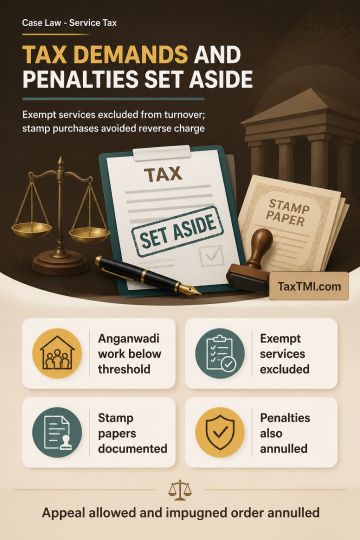
Threshold exemption excludes exempt services, while stamp-paper purchases avoid reverse charge; consequential service tax penalties were also set asid...
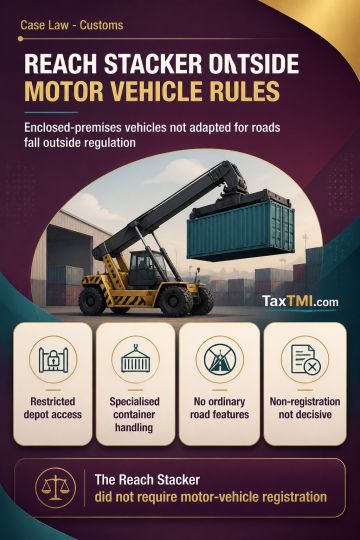
A Reach Stacker used exclusively for container handling within a restricted Inland Container Depot is described as falling outside the Motor Vehicles Act, 1988 definition of a motor vehicle because it is a special vehicle adapted only for enclosed premises. The text distinguishes road rollers, which are built for road use, and applies the test of whether a vehicle is adapted for use on roads. Restricted depot roads were not a public place because the public had no right of access. The Reach Stacker's specialised design, excess weight, dismantled transportation, lack of ordinary road-safety features and confined utility supported the exclusion. Non-registration alone was not determinative, but followed from its non-motor-vehicle status.
A Reach Stacker used exclusively for container handling within a restricted Inland Container Depot is described as falling outside the Motor Vehicles Act, 1988 definition of a motor vehicle because it is a special vehicle adapted only for enclosed premises. The text distinguishes road rollers, which are built for road use, and applies the test of whether a vehicle is adapted for use on roads. Restricted depot roads were not a public place because the public had no right of access. The Reach Stacker's specialised design, excess weight, dismantled transportation, lack of ordinary road-safety features and confined utility supported the exclusion. Non-registration alone was not determinative, but followed from its non-motor-vehicle status.
Note: It is a system-generated summary and is for quick reference only.
 TaxTMI
 of 4792



















 Join Channel


 TaxTMI
