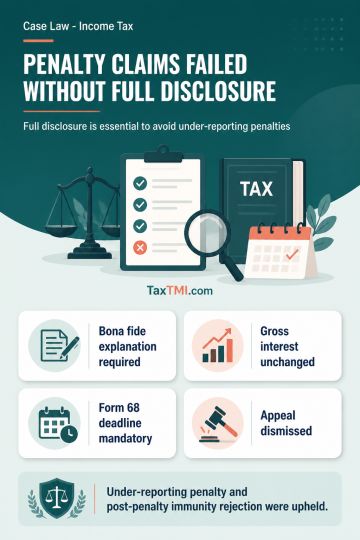
Bona fide disclosure requirements govern under-reporting penalties, and post-penalty immunity applications cannot secure available statutory protectio...
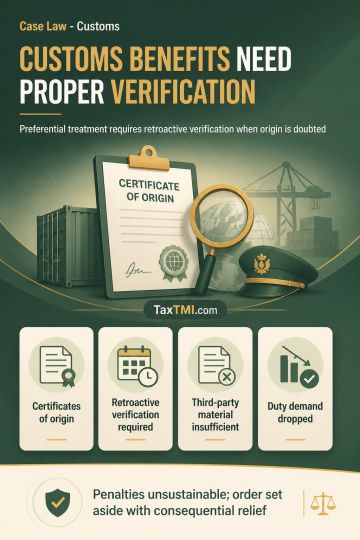
Certificate-of-origin verification procedure governs preferential customs benefits; denial without retroactive verification was set aside with consequ...
Disciplinary Committee jurisdiction and mandatory investigation requirements invalidated cancellation of an insolvency professional's registration and...
Retention of seized property survives where recorded reasons support proceeds of crime, while stayed investigation periods are excluded from limitatio...
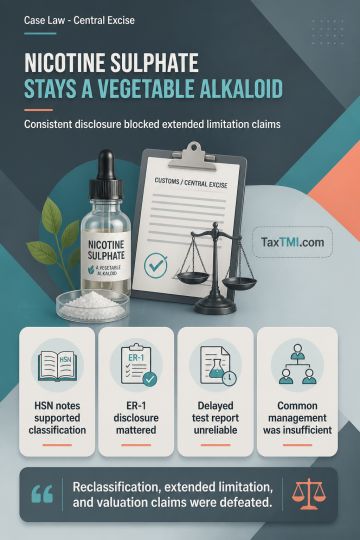
The note addresses excise classification, limitation and related-party valuation for Nicotine Sulphate. It states that consistent disclosure of manufacture and classification under CTH 29399900 in ER-1 returns precluded extended limitation absent suppression or misstatement. It explains that HSN notes treat alkaloids and derivatives as an exception to the separate chemically defined compound requirement, supporting classification of tobacco-extracted Nicotine Sulphate as a vegetable alkaloid under CTH 29399900 rather than a tobacco product. A delayed third-party sample test report was treated as unreliable, and chemical examiners were described as limited to analytical findings, not classification. Common management alone did not establish a related-party relationship without evidence satisfying the statutory test.
The note addresses excise classification, limitation and related-party valuation for Nicotine Sulphate. It states that consistent disclosure of manufacture and classification under CTH 29399900 in ER-1 returns precluded extended limitation absent suppression or misstatement. It explains that HSN notes treat alkaloids and derivatives as an exception to the separate chemically defined compound requirement, supporting classification of tobacco-extracted Nicotine Sulphate as a vegetable alkaloid under CTH 29399900 rather than a tobacco product. A delayed third-party sample test report was treated as unreliable, and chemical examiners were described as limited to analytical findings, not classification. Common management alone did not establish a related-party relationship without evidence satisfying the statutory test.
Note: It is a system-generated summary and is for quick reference only.
 TaxTMI
 of 4786











 Join Channel


 TaxTMI