Transfer pricing and tax deductions upheld on established principles, while employee contributions and warranty provisions returned for fresh examinat...
Captive transfer pricing relies on industrial consumer tariffs, while genuine quotations can benchmark effluent treatment transfers under the Other Me...
Specific tariff classification for ophthalmic instruments and extended limitation principles determine the treatment of duty demands, confiscation, an...
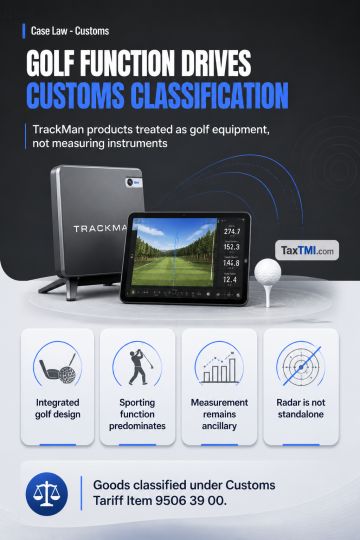
Integrated golf function determines classification, placing launch monitors and simulators under other golf equipment rather than measuring instrument...
Public servant status under anti-corruption law extends to recognised stock exchange leadership; constitutional and sanction challenges do not succeed...
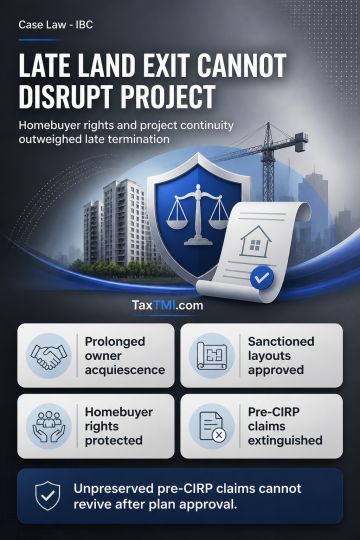
Acquiescence, homebuyer protection and clean-slate resolution principles prevent landowners from disrupting an integrated project through late termina...
Page of 4784
Press 'Enter' after typing page number.
841 to 860 of 95673 Results
❮
❯
❯❯
0 / 200
Expand Note
Add to Folder
No Folders have been created
+
Are you sure you want to delete "My most important" ?
Food supplements cannot be classified as proprietary Ayurvedic...
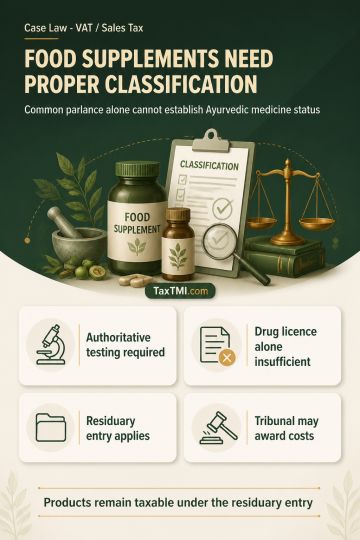
Food supplement classification requires common parlance and authoritative tests, preventing treatment as proprietary Ayurvedic medicines without supporting evidence.
Contents
Summary
Note
Bookmark
Share
✓ Copied successfully !
Print
Print Options
For full text, please login
Login to TaxTMI
Verification Pending
The Email Id has not been verified. Click on the link we have sent on
Food supplements cannot be classified as proprietary Ayurvedic medicines solely by common parlance or a manufacturer's drug licence. Classification requires both common parlance and authoritative tests, including evidence that the products are intended for diagnosis, treatment or cure. Products purchased under CST registration and sold unchanged as food supplements, without the dealer holding a drug-sale licence, remain taxable under the residuary entry. Chapter IV-A of the Drugs and Cosmetics Act continues to regulate Ayurvedic, Siddha and Unani drugs; exclusion from Chapter IV does not remove sale-licensing requirements. The Tribunal may award costs in tax appeals, as compensatory costs for vexatious litigation are an inherent power not barred by the Act.
Food supplements cannot be classified as proprietary Ayurvedic medicines solely by common parlance or a manufacturer's drug licence. Classification requires both common parlance and authoritative tests, including evidence that the products are intended for diagnosis, treatment or cure. Products purchased under CST registration and sold unchanged as food supplements, without the dealer holding a drug-sale licence, remain taxable under the residuary entry. Chapter IV-A of the Drugs and Cosmetics Act continues to regulate Ayurvedic, Siddha and Unani drugs; exclusion from Chapter IV does not remove sale-licensing requirements. The Tribunal may award costs in tax appeals, as compensatory costs for vexatious litigation are an inherent power not barred by the Act.
Note: It is a system-generated summary and is for quick reference only.
 TaxTMI
 of 4784

















 Join Channel


 TaxTMI