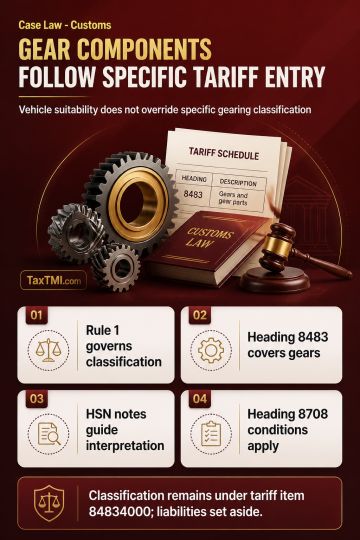
Tariff classification of vehicle gear components follows the specific gearing entry, displacing motor-vehicle parts classification and related liabili...
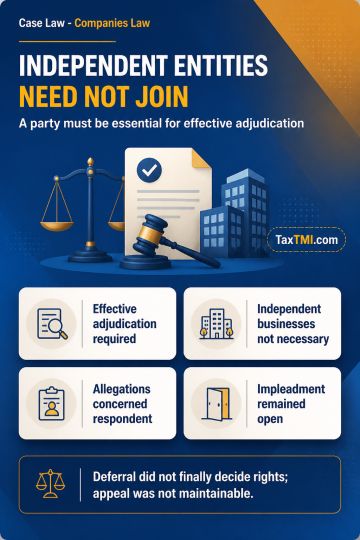
Necessary-party requirements limit impleadment of independent entities, while deferred consideration does not create an appealable adverse determinati...
Food supplement classification requires common parlance and authoritative tests, preventing treatment as proprietary Ayurvedic medicines without suppo...
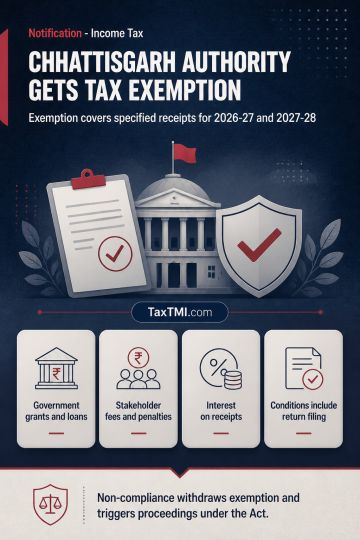
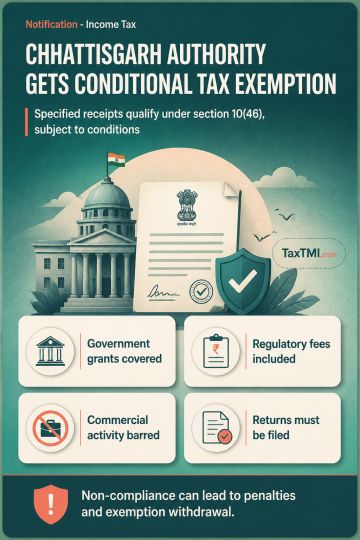
Specified regulatory authority income receives conditional tax exemption, subject to non-commercial activity, unchanged income character, and return f...
Tax exemption for regulatory authority income applies retrospectively, subject to non-commercial activity, unchanged income sources, and return-filing...
Pure reimbursement of common legal and professional expenditure,...
Pure reimbursement without income element escapes tax withholding, while delayed withholding and unsupported provisions face deferred or renewed scrutiny.
Contents
Summary
Note
Bookmark
Share
✓ Copied successfully !
Print
Print Options
For full text, please login
Login to TaxTMI
Verification Pending
The Email Id has not been verified. Click on the link we have sent on
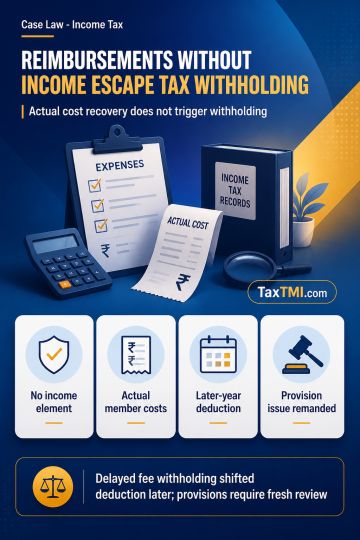
Pure reimbursement of common legal and professional expenditure, without an income element in the recipient association's recovery, does not attract tax deduction at source; accounting labels do not determine the payment's true character. The related disallowance was deleted because the association had apportioned actual member costs and had deducted tax when paying legal professionals. Where tax was deducted and deposited subsequently on professional-fee payments, the expenditure was not allowable in the relevant year but could be claimed in the subsequent year subject to statutory verification. Year-end provisions require party-wise evidence showing that each liability was ascertained, accrued and incurred for business purposes; the provision issue was remanded for fresh examination.
Pure reimbursement of common legal and professional expenditure, without an income element in the recipient association's recovery, does not attract tax deduction at source; accounting labels do not determine the payment's true character. The related disallowance was deleted because the association had apportioned actual member costs and had deducted tax when paying legal professionals. Where tax was deducted and deposited subsequently on professional-fee payments, the expenditure was not allowable in the relevant year but could be claimed in the subsequent year subject to statutory verification. Year-end provisions require party-wise evidence showing that each liability was ascertained, accrued and incurred for business purposes; the provision issue was remanded for fresh examination.
Note: It is a system-generated summary and is for quick reference only.
 TaxTMI
 of 4780











 Join Channel


 TaxTMI
