Employee recoveries, input tax credit and notice pay recovery under GST: AAR distinguishes taxable supplies from non-taxable perquisites and penalties...
Liberal construction of sufficient cause justifies condonation of inordinate delay where criminal proceedings and jail confinement explained the defau...
Page of 4826
Press 'Enter' after typing page number.
5041 to 5060 of 96510 Results
❮
❯
❯❯
0 / 200
Expand Note
Add to Folder
No Folders have been created
+
Are you sure you want to delete "My most important" ?
Charitable registration requires a public benefit founded on...
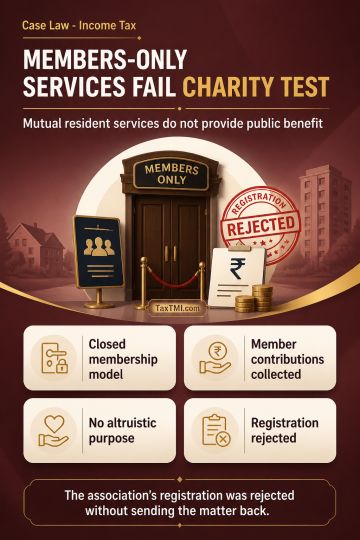
Public benefit requirement defeats charitable registration where residents' association services are reciprocal, member-only facilities governed by mutuality.
Contents
Summary
Note
Bookmark
Share
✓ Copied successfully !
Print
Print Options
For full text, please login
Login to TaxTMI
Verification Pending
The Email Id has not been verified. Click on the link we have sent on
Charitable registration requires a public benefit founded on altruism, not reciprocal advantages within a closed membership. A residents' welfare association that collects member contributions and provides maintenance, security, housekeeping and common facilities solely to residents of one housing complex operates on mutuality and provides reciprocal services, rather than pursuing a charitable purpose. The absence of profit motive does not convert members' mutual convenience into charity. Its objects and activities therefore did not meet the charitable-purpose requirement for registration under section 12AB. Although only one hearing was provided, remand was unnecessary because the admitted nature of its activities made further evidence immaterial. Registration was rejected and no remand was directed.
Charitable registration requires a public benefit founded on altruism, not reciprocal advantages within a closed membership. A residents' welfare association that collects member contributions and provides maintenance, security, housekeeping and common facilities solely to residents of one housing complex operates on mutuality and provides reciprocal services, rather than pursuing a charitable purpose. The absence of profit motive does not convert members' mutual convenience into charity. Its objects and activities therefore did not meet the charitable-purpose requirement for registration under section 12AB. Although only one hearing was provided, remand was unnecessary because the admitted nature of its activities made further evidence immaterial. Registration was rejected and no remand was directed.
Note: It is a system-generated summary and is for quick reference only.
 TaxTMI
  TaxTMI
 of 4826


 Join Channel