Development agreements require legal possession or effective enjoyment for capital gains transfer; permissive possession and deferred consideration de...
Prolonged sterilisation of development rights supports capital-gains treatment, while business-income disallowances cannot govern capital-gains comput...
Additional evidence in transfer pricing dispute leads to fresh examination, while tax deductions, TDS credit, fee and refund interest require verifica...
Category II AIF pass-through taxation preserves non-business income character; investment receipts cannot be reclassified without applying recognised ...
Mutual fund maturity rules require proper rollover, redemption, disclosure, and due diligence; investor gains cannot excuse regulatory breaches or pen...
Expenditure relating to exempt income is discussed as being...
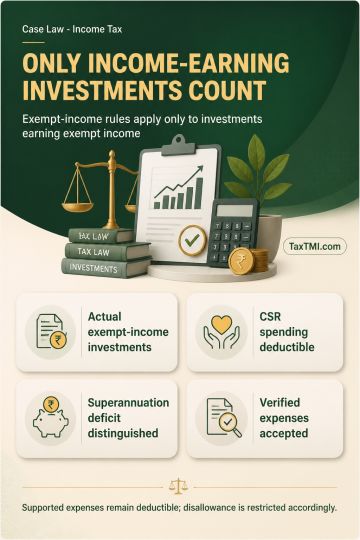
Exempt-income expenditure disallowance is confined to investments that actually generated exempt income, while supported business expenses remain deductible.
Contents
Summary
Note
Bookmark
Share
✓ Copied successfully !
Print
Print Options
For full text, please login
Login to TaxTMI
Verification Pending
The Email Id has not been verified. Click on the link we have sent on
Expenditure relating to exempt income is discussed as being disallowable under section 14A read with Rule 8D only by reference to investments that actually generated exempt income during the relevant year; the computation was restricted accordingly. Corporate social responsibility expenditure incurred by a statutory port authority under Ministry guidelines is treated as deductible where the Companies Act exclusion does not apply and earlier-year treatment was consistent. Payments to meet an actuarially certified superannuation-fund deficit are distinguished from ordinary annual contributions subject to Rule 87 limits. Software expenditure supported by invoices, banking payments and tax deduction evidence is treated as genuine despite the payee's non-compliance. Accrued expenses recorded under the prescribed accrual-accounting framework are treated as ascertained liabilities.
Expenditure relating to exempt income is discussed as being disallowable under section 14A read with Rule 8D only by reference to investments that actually generated exempt income during the relevant year; the computation was restricted accordingly. Corporate social responsibility expenditure incurred by a statutory port authority under Ministry guidelines is treated as deductible where the Companies Act exclusion does not apply and earlier-year treatment was consistent. Payments to meet an actuarially certified superannuation-fund deficit are distinguished from ordinary annual contributions subject to Rule 87 limits. Software expenditure supported by invoices, banking payments and tax deduction evidence is treated as genuine despite the payee's non-compliance. Accrued expenses recorded under the prescribed accrual-accounting framework are treated as ascertained liabilities.
Note: It is a system-generated summary and is for quick reference only.
 TaxTMI
 of 4786



















 Join Channel


 TaxTMI
