Capital reduction is distinct from share buy-back, preventing buy-back tax; restructuring interest and related business deductions also survive scruti...
Transfer pricing and tax deductions upheld on established principles, while employee contributions and warranty provisions returned for fresh examinat...
Captive transfer pricing relies on industrial consumer tariffs, while genuine quotations can benchmark effluent treatment transfers under the Other Me...
Specific tariff classification for ophthalmic instruments and extended limitation principles determine the treatment of duty demands, confiscation, an...
Integrated golf function determines classification, placing launch monitors and simulators under other golf equipment rather than measuring instrument...
Public servant status under anti-corruption law extends to recognised stock exchange leadership; constitutional and sanction challenges do not succeed...
Page of 4786
Press 'Enter' after typing page number.
881 to 900 of 95714 Results
❮
❯
❯❯
0 / 200
Expand Note
Add to Folder
No Folders have been created
+
Are you sure you want to delete "My most important" ?
Expenditure relating to exempt income is discussed as being...
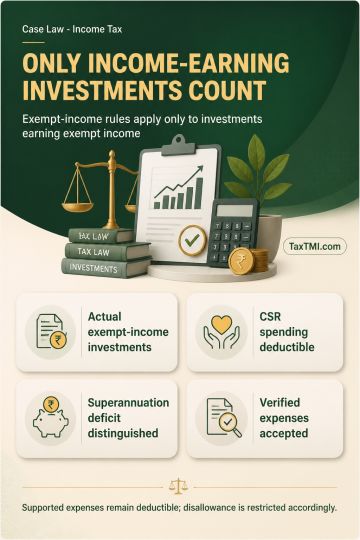
Exempt-income expenditure disallowance is confined to investments that actually generated exempt income, while supported business expenses remain deductible.
Contents
Summary
Note
Bookmark
Share
✓ Copied successfully !
Print
Print Options
For full text, please login
Login to TaxTMI
Verification Pending
The Email Id has not been verified. Click on the link we have sent on
Expenditure relating to exempt income is discussed as being disallowable under section 14A read with Rule 8D only by reference to investments that actually generated exempt income during the relevant year; the computation was restricted accordingly. Corporate social responsibility expenditure incurred by a statutory port authority under Ministry guidelines is treated as deductible where the Companies Act exclusion does not apply and earlier-year treatment was consistent. Payments to meet an actuarially certified superannuation-fund deficit are distinguished from ordinary annual contributions subject to Rule 87 limits. Software expenditure supported by invoices, banking payments and tax deduction evidence is treated as genuine despite the payee's non-compliance. Accrued expenses recorded under the prescribed accrual-accounting framework are treated as ascertained liabilities.
Expenditure relating to exempt income is discussed as being disallowable under section 14A read with Rule 8D only by reference to investments that actually generated exempt income during the relevant year; the computation was restricted accordingly. Corporate social responsibility expenditure incurred by a statutory port authority under Ministry guidelines is treated as deductible where the Companies Act exclusion does not apply and earlier-year treatment was consistent. Payments to meet an actuarially certified superannuation-fund deficit are distinguished from ordinary annual contributions subject to Rule 87 limits. Software expenditure supported by invoices, banking payments and tax deduction evidence is treated as genuine despite the payee's non-compliance. Accrued expenses recorded under the prescribed accrual-accounting framework are treated as ascertained liabilities.
Note: It is a system-generated summary and is for quick reference only.
 TaxTMI
 of 4786




















 Join Channel


 TaxTMI