Admissibility of electronic evidence bars undervaluation demands where printouts, retracted statements and no cross-examination leave the case unprove...
Limitation in oppression and mismanagement proceedings: prior knowledge of removal and dilution barred the challenge, with valuation directions upheld...
Page of 4809
Press 'Enter' after typing page number.
3221 to 3240 of 96174 Results
❮
❯
❯❯
0 / 200
Expand Note
Add to Folder
No Folders have been created
+
Are you sure you want to delete "My most important" ?
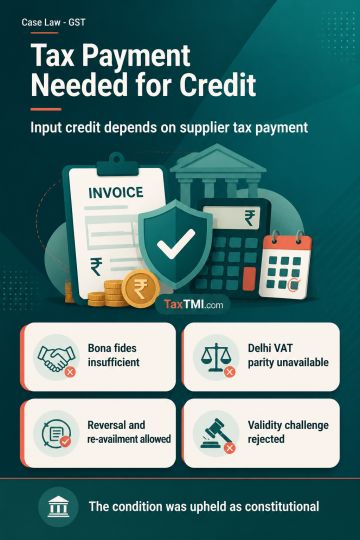
Input Tax Credit under Section 16(2)(c) of the CGST Act remains conditional on the supplier's payment of tax, even where the purchasing dealer asserts bona fides. The text distinguishes the CGST framework from the Delhi VAT regime because CGST provides for reversal and subsequent re-availment of credit after the supplier discharges the tax liability. A purchaser therefore cannot claim parity with a bona fide purchaser under Delhi VAT when its supplier defaults. The condition was upheld as constitutional and not liable to be read down, and the challenge to its validity was rejected.
Input Tax Credit under Section 16(2)(c) of the CGST Act remains conditional on the supplier's payment of tax, even where the purchasing dealer asserts bona fides. The text distinguishes the CGST framework from the Delhi VAT regime because CGST provides for reversal and subsequent re-availment of credit after the supplier discharges the tax liability. A purchaser therefore cannot claim parity with a bona fide purchaser under Delhi VAT when its supplier defaults. The condition was upheld as constitutional and not liable to be read down, and the challenge to its validity was rejected.
Note: It is a system-generated summary and is for quick reference only.
 TaxTMI
  TaxTMI
 of 4809


 Join Channel