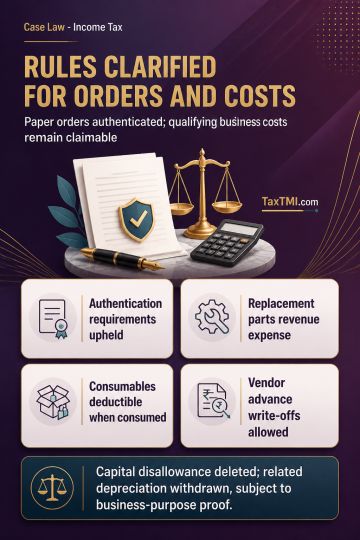
Authentication of paper assessment orders upheld, while qualifying repairs, consumables and vendor advance write-offs remain deductible business claim...
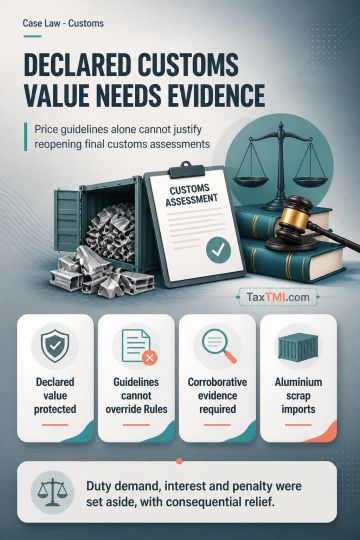
Transaction value cannot be rejected solely on non-statutory valuation guidelines without corroborative evidence supporting reassessment of final cust...
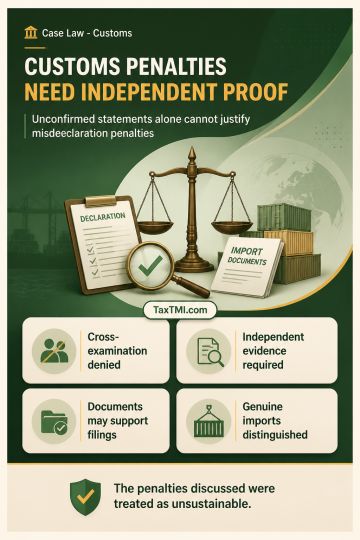
Cross-examination rights and corroborated evidence limit customs penalties for misdeclaration in genuine import transactions involving documented clea...
Page of 4780
Press 'Enter' after typing page number.
261 to 280 of 95596 Results
❮
❯
❯❯
0 / 200
Expand Note
Add to Folder
No Folders have been created
+
Are you sure you want to delete "My most important" ?
Higher-rate depreciation on a windmill turns on whether it was...
Windmill commissioning evidence supported higher depreciation where grid connection and electricity generation proved operational use before the relevant date.
Contents
Summary
Note
Bookmark
Share
✓ Copied successfully !
Print
Print Options
For full text, please login
Login to TaxTMI
Verification Pending
The Email Id has not been verified. Click on the link we have sent on
Higher-rate depreciation on a windmill turns on whether it was commissioned and exported electricity before the relevant date. The notes state that a commissioning certificate, grid-interconnection evidence, electricity-generation report and contemporaneous readiness letter supported commissioning in September 2004. They contrast this material with reliance on missing transport and insurance documents, characterising the latter approach as ignoring relevant evidence. The reported conclusion is that the windmill qualified for depreciation at the higher rate, with the appellate authority's position restored.
Higher-rate depreciation on a windmill turns on whether it was commissioned and exported electricity before the relevant date. The notes state that a commissioning certificate, grid-interconnection evidence, electricity-generation report and contemporaneous readiness letter supported commissioning in September 2004. They contrast this material with reliance on missing transport and insurance documents, characterising the latter approach as ignoring relevant evidence. The reported conclusion is that the windmill qualified for depreciation at the higher rate, with the appellate authority's position restored.
Note: It is a system-generated summary and is for quick reference only.
 TaxTMI
 of 4780













 Join Channel



 TaxTMI