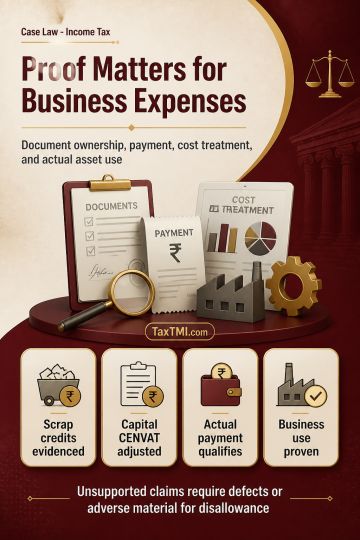
Business expenditure substantiation supports scrap credits, statutory payments and expense claims, while depreciation requires proof of actual busines...
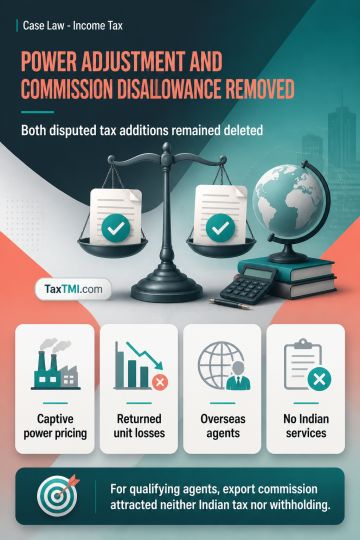
Captive power transfer pricing and non-resident export commission rules support deletion of adjustments and withholding disallowance in discussed proc...
Page of 4782
Press 'Enter' after typing page number.
401 to 420 of 95636 Results
❮
❯
❯❯
0 / 200
Expand Note
Add to Folder
No Folders have been created
+
Are you sure you want to delete "My most important" ?
Business expenditure, statutory liabilities and depreciation are...
Business expenditure substantiation supports scrap credits, statutory payments and expense claims, while depreciation requires proof of actual business use.
Contents
Summary
Note
Bookmark
Share
✓ Copied successfully !
Print
Print Options
For full text, please login
Login to TaxTMI
Verification Pending
The Email Id has not been verified. Click on the link we have sent on
Business expenditure, statutory liabilities and depreciation are addressed through principles governing scrap credits, CENVAT adjustments, actual payment and business use of assets. Scrap credits passed to a job-work customer are treated as an ascertained commercial liability where customer ownership, quantification and payment are evidenced. Only CENVAT credit attributable to capital assets reduces depreciable cost; tools, spares and stores treated as revenue items do not form part of the depreciable block. Statutory excise duty and crystallised performance incentives are allowable on qualifying actual payment. Depreciation requires evidence that assets were actually put to business use. Ad hoc expense disallowances require identified defects or cogent adverse material, and TDS-receipt differences require proof of unaccounted income.
Business expenditure, statutory liabilities and depreciation are addressed through principles governing scrap credits, CENVAT adjustments, actual payment and business use of assets. Scrap credits passed to a job-work customer are treated as an ascertained commercial liability where customer ownership, quantification and payment are evidenced. Only CENVAT credit attributable to capital assets reduces depreciable cost; tools, spares and stores treated as revenue items do not form part of the depreciable block. Statutory excise duty and crystallised performance incentives are allowable on qualifying actual payment. Depreciation requires evidence that assets were actually put to business use. Ad hoc expense disallowances require identified defects or cogent adverse material, and TDS-receipt differences require proof of unaccounted income.
Note: It is a system-generated summary and is for quick reference only.
 TaxTMI
 of 4782



 Join Channel


 TaxTMI