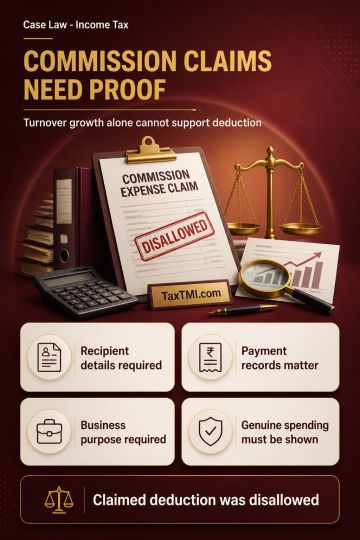
Business expenditure deduction requires proof of genuine commission payments and commercial allowability; turnover growth alone cannot validate the cl...
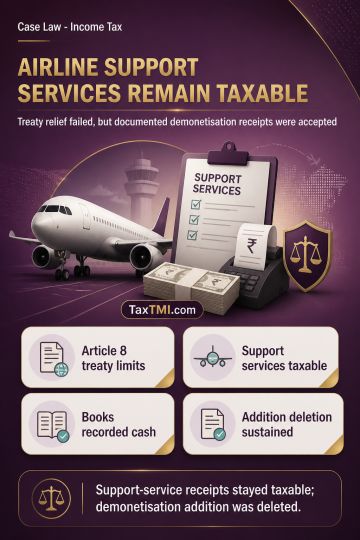
Article 8 treaty coverage excluded third-party airline support services, while documented demonetisation cash receipts remained accepted business inco...
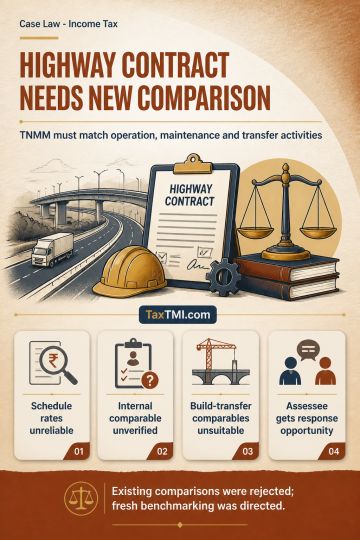
Functional comparability under TNMM requires highway contract benchmarks to reflect operation, maintenance and transfer activities, requiring fresh be...
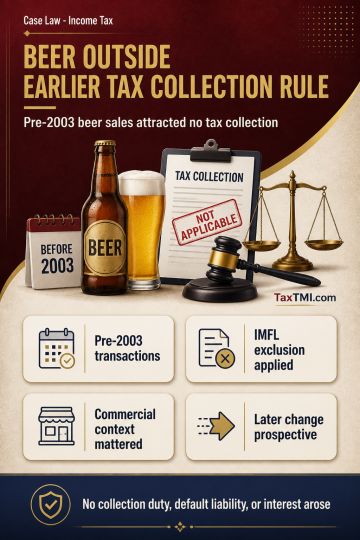
For sales before 1 June 2003, the tax-collection-at-source entry for alcoholic liquor for human consumption expressly excluded Indian Made Foreign Liquor (IMFL). As IMFL was undefined in the Income-tax Act, its meaning was considered in commercial and statutory context; the Tribunal's classification of beer as IMFL was treated as a reasonable view. State excise classifications could assist but could not control the Income-tax Act. The later deletion of the IMFL exclusion broadened the entry prospectively. Consequently, beer sales fell outside the earlier entry, so no tax-collection obligation, default liability, or consequential interest arose.
For sales before 1 June 2003, the tax-collection-at-source entry for alcoholic liquor for human consumption expressly excluded Indian Made Foreign Liquor (IMFL). As IMFL was undefined in the Income-tax Act, its meaning was considered in commercial and statutory context; the Tribunal's classification of beer as IMFL was treated as a reasonable view. State excise classifications could assist but could not control the Income-tax Act. The later deletion of the IMFL exclusion broadened the entry prospectively. Consequently, beer sales fell outside the earlier entry, so no tax-collection obligation, default liability, or consequential interest arose.
Note: It is a system-generated summary and is for quick reference only.
 TaxTMI
 of 4784





 Join Channel


 TaxTMI
